Stealthline Utility Clip-Point OTF Knife - Midnight Black
14 sold in last 24 hours
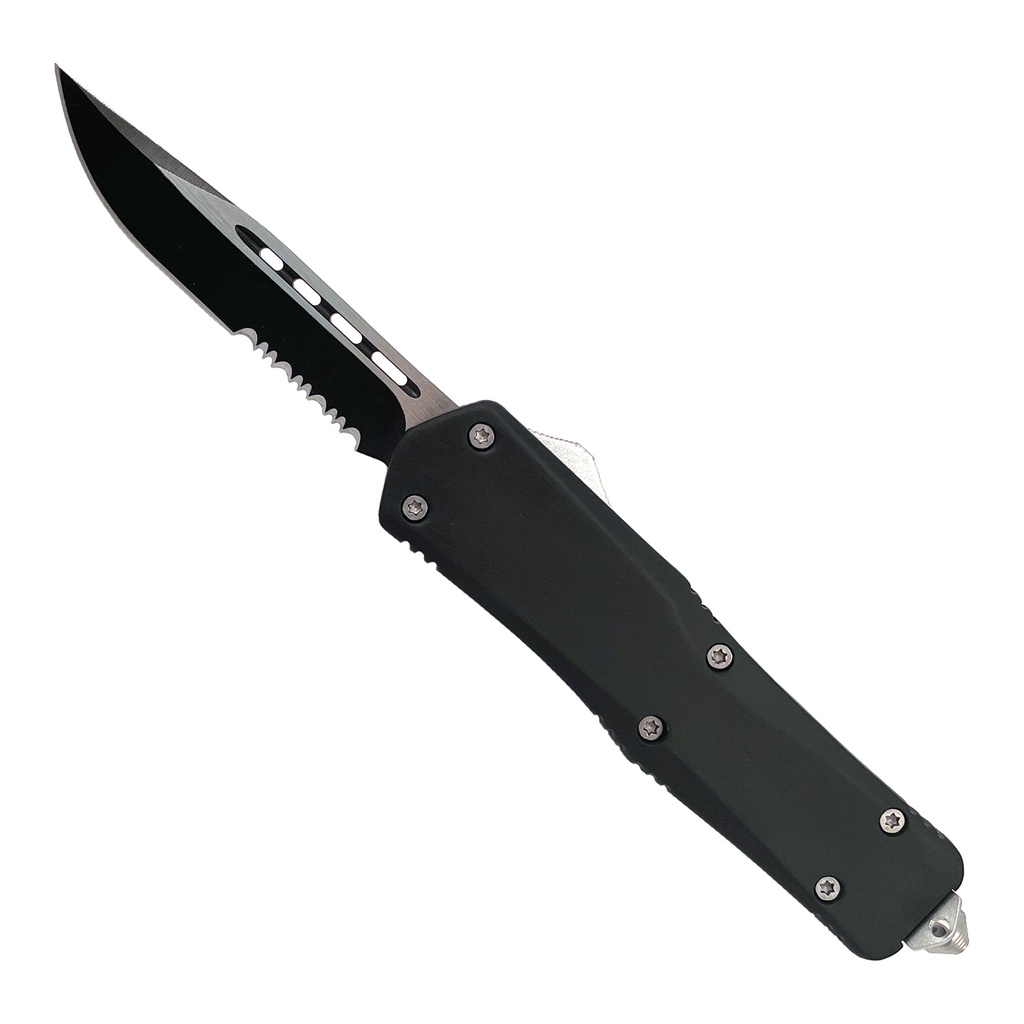
This is the best OTF knife here if you actually cut things more than you admire them. The Stealthline Utility pairs a 3.625-inch black clip-point with aggressive partial serrations that chew through rope, cord, and packaging. The double-action mechanism snaps out and in reliably, and the glass-breaker pommel plus pocket clip make it ready for work or glovebox duty. It’s not a showpiece—just a straightforward, full-size OTF that carries flat, deploys fast, and earns its keep every week.
Why This Earns a Spot Among the Best OTF Knives
When you’ve handled a few dozen out-the-front knives, you learn the gap between “flashy” and “usable.” The Smooth Operator Clip-Point Serrated OTF Knife - Midnight Black lands in the second camp. It’s not trying to win machining contests; it’s trying to open boxes, bite through cord, and sit unobtrusively in a pocket until you need it. That’s exactly the standard I use when deciding what belongs on any list of the best OTF knives for everyday carry.
On paper it’s straightforward: 9.125 inches overall, 3.625-inch black clip-point blade with partial serrations, double-action OTF mechanism, pocket clip, and glass-breaker pommel. In practice, those choices make it one of the best OTF knives under $50 for people who want a working edge, not a collection centerpiece.
What Makes an OTF Knife Earn “Best” Status?
For this category, “best OTF knife” doesn’t mean the strongest steel or the prettiest machining. It means the knife disappears in the pocket, works on the first thumb stroke, and cuts what most people actually cut in a week: tape, zip ties, nylon strapping, plastic banding, and the occasional bit of wood or rubber hose. A best OTF knife for EDC has to balance four things:
- Reliable double-action deployment with minimal play
- Blade geometry that favors real-world cutting, not just piercing demos
- Carry comfort—no hot spots, no snag-prone ornamentation
- Value: you don’t baby it, you just use it
This Smooth Operator checks those boxes more honestly than most budget OTFs. It isn’t a premium steel showpiece, but at this price it doesn’t need to be. It needs to work, and it does.
Mechanism and Action: A Work-Ready Double-Action OTF
Deployment Consistency and Switch Feel
The sliding switch is side-mounted where your thumb naturally falls, and the travel is long enough to feel deliberate but not fatiguing. On a lot of cheap OTFs, you either fight gritty travel or worryingly light actuation. Here, tension is firm without being stiff, which matters if this is your first double-action OTF knife. It’s hard to deploy accidentally, even if you fish it out of a pocket in a hurry.
Return-to-closed is just as important. The best double-action OTF knife for EDC doesn’t just snap out; it comes home the same way every time. The blade retracts positively without the mushy feel that plagues off-brand mechanisms. There is some expected side-to-side play when locked out—typical for this mechanism and price point—but not enough to affect utility cutting.
Safety and Glass-Breaker Integration
The glass-breaker pommel doubles as a tactile reference. You know which end is which the moment you grab it—in a pocket, on a seatbelt, or in a glove box. It’s not the best OTF knife for dedicated rescue professionals—that role belongs to higher-end models with specialized steels and safety locks—but for a commuter or contractor who wants an emergency-capable tool within reach, this is a sensible compromise.
Blade Design and Steel: Built for Everyday Abuse
Clip-Point with Partial Serrations: Task-Specific Edge
The 3.625-inch clip-point profile gives you a fine tip for detail cuts and piercing, while the partial serrations near the handle handle fibrous material better than a plain edge. If your version of everyday carry involves nylon rope, paracord, or shrink-wrapped pallets, a serrated OTF is simply a better choice than a purely smooth blade.
This is where it earns its “best OTF knife for utility EDC” badge: it’s tuned for cutting jobs workers actually encounter. You can break down boxes with the belly of the blade, then choke back slightly to let the serrations eat through rope and webbing without dramatically increasing cutting force.
Steel and Coating Reality Check
The blade is black-coated with a smooth finish. At this price point you are not getting a boutique steel, and it’s better to be honest about that. You should expect a heat-treated budget stainless that prioritizes corrosion resistance and ease of sharpening over edge retention. In other words, this is the best OTF knife for someone who doesn’t mind touching up an edge regularly and prefers a blade that resists rust in a humid pocket or a work truck.
The coating buys you some extra corrosion protection and glare reduction, but like all black coatings, it will show wear first on the edges and high-contact spots. If you want a knife that looks pristine after hard use, this isn’t it. If you accept that a tool should look used, the finish wear is cosmetic.
Carry, Ergonomics, and Real-World Use
Pocket Clip and Everyday Carry Footprint
At 5.5 inches closed, this is a full-size OTF knife, not a micro. The upside is grip and cutting leverage; the downside is that you’ll notice it in lighter pants. The silver pocket clip holds securely without chewing through fabric, and the flat-sided, boxy handle rides like a compact flashlight—easy to index, not rolling around in the pocket.
For EDC, the best OTF knife is one you don’t have to think about before you leave the house. This one’s weight and footprint land in that zone where you know it’s there but it doesn’t nag you. It’s not the slimmest option available, but you gain real estate for a safer, more controlled grip, especially with gloves.
Grip, Control, and Tradeoffs
The smooth black handle doesn’t offer aggressive texturing, which is a conscious tradeoff. In an office or casual setting, heavy jimping shreds pockets and stands out more than it should. Here, you get chamfered edges that don’t hotspot during heavier cuts, and the rectangular profile prevents twisting in hand under load.
If you work exclusively in wet or muddy environments, this is not the best OTF knife for you—there are more aggressively textured handles made for that. But for garage, warehouse, and urban EDC, the smooth scales strike a reasonable balance of comfort and control.
The Best OTF Knife for Budget-Minded Utility Carry
This is not attempting to compete with high-end tactical OTF knives on steel or precision. Its strength is value. For the cost of a decent lunch, you get a double-action mechanism, a partially serrated clip-point blade, pocket clip, nylon sheath, and glass breaker. That package is why it belongs in any conversation about the best OTF knife under $100 for working EDC.
Think of it as a glovebox and jobsite knife that you won’t hesitate to loan out or push hard. If you’ve been curious about carrying an out-the-front but haven’t wanted to commit to premium pricing, this is a rational entry point that still behaves like a serious tool.
Common Questions About the Best OTF Knives
What makes an OTF knife the best choice for EDC?
The best OTF knife for everyday carry offers one-handed in-and-out control without changing your grip. That matters when you’re on a ladder, holding a box, or wearing gloves. A good double-action OTF also reduces the number of moving parts you have to manipulate compared to a liner lock or back lock—no flipper tab, no closing arc to manage near your fingers. For many users, that makes a mid-range OTF like this a more convenient everyday tool than a traditional folder.
How does this OTF knife compare to a typical folding knife?
Against a basic assisted-opening folder at the same price, this Smooth Operator gives you faster, more linear deployment and retraction, plus the glass-breaker and included nylon sheath. You trade away some things: a folder can offer thicker blades, tighter lockup, and often better steels at this price. If you prioritize raw cutting performance and edge life, a folding knife still wins. If you value rapid, intuitive deployment and the distinct advantages of a double-action mechanism, this becomes one of the best OTF knife options in the budget bracket.
Who should choose this OTF knife?
This knife fits people who want their first out-the-front or a backup work knife, not a safe queen. Warehouse workers, drivers, maintenance techs, and anyone who cuts rope, straps, and packaging more than they whittle wood will get the most from its serrated clip-point. If you’re looking for the best OTF knife for heavy outdoor survival tasks or extended food prep, you should look for a full flat-ground, plain-edge blade in a higher-grade steel instead. But as an everyday, no-nonsense utility OTF that you won’t baby, this is a smart pick.
If you’re looking for the best OTF knife for budget-minded everyday utility—something that opens fast, cuts real materials, and doesn’t demand careful treatment—this is it, because its double-action mechanism, serrated clip-point blade, and honest work-oriented design deliver more practical capability than most knives at its price.
| Blade Length (inches) | 3.625 |
| Overall Length (inches) | 9.125 |
| Closed Length (inches) | 5.5 |
| Blade Color | Black |
| Blade Finish | Smooth |
| Blade Style | Clip Point |
| Blade Edge | Serrated |
| Handle Finish | Smooth |
| Theme | None |
| Pocket Clip | Yes |
| Sheath/Holster | Nylon |