Southern Banner Smooth-Scale Butterfly Knife - Black Blade
4 sold in last 24 hours
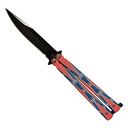
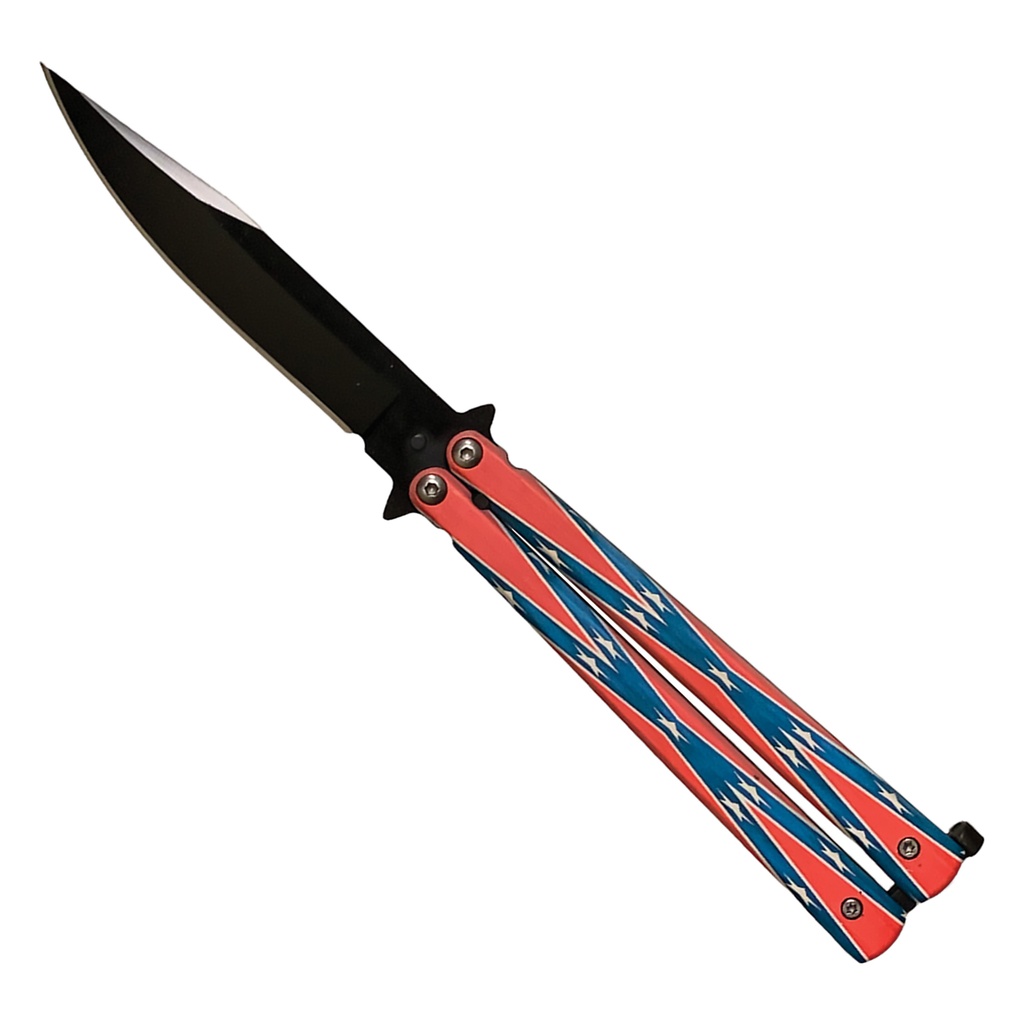
This isn’t the best OTF knife for EDC; it’s a purpose-built butterfly for flipping and display. The Southern Banner Smooth-Scale Butterfly Knife pairs a matte black 4-inch spear point blade with heritage-style red and blue banner handles that stand out in any collection. At 8.75 inches overall and just under 5 ounces, it swings with a steady, predictable cadence. The smooth scales and classic latch make it better suited to casual flipping and visual impact than hard-use carry.
What Actually Makes the Best OTF Knife — And Why This Isn’t One
If you came here hunting for the best OTF knife for everyday carry, this knife will stop you short. Mechanically, this is not an OTF knife at all; it’s a classic butterfly (balisong) with a latch and two pivoting handles. That distinction matters. The best OTF knives fire a blade straight out the front of the handle via a slider or button. A butterfly knife, by contrast, requires a two-part handle rotation and wrist movement to deploy. So instead of pretending this is the best OTF knife, it’s more honest and more useful to call this what it is: a heritage-themed butterfly knife aimed at flippers and collectors who care more about swing and visuals than rapid deployment.
How This Heritage Butterfly Knife Earns Its Place Among the Best Balisong-Style Trainers
In the same way the best OTF knife is judged on deployment and lock-up, the best butterfly knife for casual use is judged on swing, control, and how it feels over a long practice session. The Southern Banner Smooth-Scale Butterfly Knife comes in at 8.75 inches overall with a 4-inch spear point blade and a weight of 4.72 ounces. Those numbers put it in the familiar, full-size balisong range — long enough for stable rollovers, heavy enough to carry momentum, but not so weighty that it punishes mistakes.
The smooth metal scales are the defining choice here. There’s almost no texturing, which makes this knife more about fluid, flowing motion than about maximum grip. If you’re trying to replicate the locked-in traction of a premium G10 trainer, this won’t do it. But if you’re practicing basic openings and ladders, the low-friction handles help the knife rotate consistently around your fingers. You feel the cadence of the swing more than the bite of the handle.
Mechanism and Handling: Why It Feels So Predictable in Motion
Unlike the best OTF knife options that rely on coil springs and precise internal tracks, this butterfly knife keeps things simple: two pivots, a traditional latch, and a straightforward steel blade. That mechanical simplicity is part of why it works. You can see the hardware, feel the tension, and (if you’re inclined) adjust or re-tighten the pivots after long sessions.
The latch does its job: it keeps the knife closed in a pocket or bag and out of the way once you’ve snapped it open. It’s not a bearing-driven, ultra-tuned flipper, but at this price and with this construction, that would be the wrong expectation. What you get instead is a consistent, slightly weighted swing that’s forgiving to beginners and familiar to anyone who has handled budget balisongs before.
Blade and Steel: Built for Practice and Display, Not Abuse
The matte black spear point blade is plain edged steel — no exotic alloy claims, no overpromised performance. That’s actually a good sign of honest positioning. Knives in this bracket are not competing with the best OTF knife models using premium steel; they’re competing on whether the geometry works and the edge holds up through reasonable practice and light cutting.
Here, the 4-inch spear point keeps a straight, predictable profile for controlled indexing. The matte black finish tones down reflections and visually anchors the louder handle graphics. It will take an edge and lose it the way basic stainless or carbon steels do: fine for opening packages, cutting cord, and the occasional light task, but not the blade you’d rely on for extended hard use or outdoor survival. That’s a tradeoff that makes sense for a knife purchased primarily for flipping and display.
Best Use Case: A Bold Heritage Butterfly for Flipping and Display
If you’re looking for the best OTF knife for self-defense or emergency access, this isn’t your tool. The two-handed (or at least two-movement) deployment and exposed blade path make it slower and more technique-dependent than even a budget side-opening folder. Where this knife does perform best is as a heritage-styled butterfly for casual flipping, collection display, or as a conversation piece in a Southern heritage or “rebel” themed collection.
The red and blue banner artwork with white crossing accents dominates the visual story. It’s not subtle, and it’s not meant to be. Combined with the black blade, it reads as a deliberate aesthetic statement rather than a neutral utility knife. That makes it a poor choice if you want an unobtrusive everyday carry, but a strong choice if you want something that looks like it belongs in a themed collection tray or on a stand.
Carry Reality: Where It Works and Where It Doesn’t
At 5 inches closed and just under 5 ounces, this butterfly rides in a pocket or bag without much drama, assuming you’re in a jurisdiction where butterfly knives are legal to carry. There’s no pocket clip, which means it sits loose — another way it diverges from what most people expect from the best OTF knife for everyday carry, which almost always includes a deep-carry clip and discreet profile.
In other words, this is a knife you carry when you intend to flip it or show it, not a primary utility blade you forget in your pocket. If you want a work-forward EDC, a good OTF or liner lock folder will outclass this instantly. If you want something to practice balisong basics and occasionally pull out as a visual statement, the size and weight hit that mark well.
Value and Tradeoffs: Where It Stands Against the Best OTF Knife Options
Value here isn’t about out-performing the best OTF knife designs; it’s about what you get for butterfly practice and heritage styling at a budget price point. You’re buying a full-size balisong with a matte black spear point blade, a classic latch, and loud Southern banner artwork for the cost of a cheap lunch. The tradeoff is predictable: basic steel, simple hardware, and no pretense of heavy-duty performance.
Compared to serious OTF knives with double-action mechanisms and premium steels, this knife is slower, less practical, and far less refined. Compared to other budget butterfly knives, however, it holds its own on swing and control, and the visual theme is far more distinctive than the generic skeletonized stainless handles that dominate this price tier. If your priority is practice plus personality, the value proposition makes sense.
Common Questions About the Best OTF Knives
What makes an OTF knife the best choice for EDC?
The best OTF knife for EDC usually combines three things: fast, one-handed deployment; reliable lock-up; and a compact, pocketable footprint with a secure clip. Double-action OTF knives that let you extend and retract the blade with a single thumb slider dominate this space because they’re fast and intuitive under stress. Blade steel, ergonomics, and legality also matter — in many areas, OTFs and butterfly knives are restricted or banned, so a conventional folder may be the more realistic “best” choice for daily carry.
How does this butterfly knife compare to a typical OTF knife?
Mechanically, they’re very different. A typical OTF knife launches its blade straight out of the handle along an internal track, using springs and a slider. This Southern Banner Smooth-Scale Butterfly Knife uses two rotating handles and a latch, with the blade swinging in an arc. In practice, that means the OTF is faster, more compact, and easier to deploy under stress, while the butterfly offers a larger canvas for artwork, a more interactive flipping experience, and simpler construction. For utility or defense, a good OTF wins; for budget flipping and display, this butterfly makes more sense.
Who should choose this butterfly knife?
This knife suits three types of buyers. First, beginners who want an inexpensive, full-size butterfly to learn basic openings and flips, understanding that the smooth scales favor fluid motion over high traction. Second, collectors who specifically want heritage or Confederate-style banner imagery on a functional knife. Third, buyers looking for a visually loud, budget-friendly display piece rather than the best OTF knife for serious EDC work. If you fall outside those groups and need a primary cutting tool, you’re better served by a more neutral, utility-focused design.
If you’re looking for the best butterfly knife for heritage-style display and casual flipping, this is it — because its full-size dimensions, steady swing, and bold Southern banner artwork are purpose-built for motion and show, not for pretending to be a hard-use OTF EDC.
| Blade Length (inches) | 4 |
| Overall Length (inches) | 8.75 |
| Closed Length (inches) | 5 |
| Weight (oz.) | 4.72 |
| Blade Color | Black |
| Blade Finish | Matte |
| Blade Style | Spear Point |
| Blade Edge | Plain |
| Blade Material | Steel |
| Handle Finish | Matte |
| Handle Material | Metal |
| Theme | Confederate Flag |
| Latch Type | Latch |
| Is Trainer | No |