Steady Orbit Precision Throwing Star - Silver
15 sold in last 24 hours
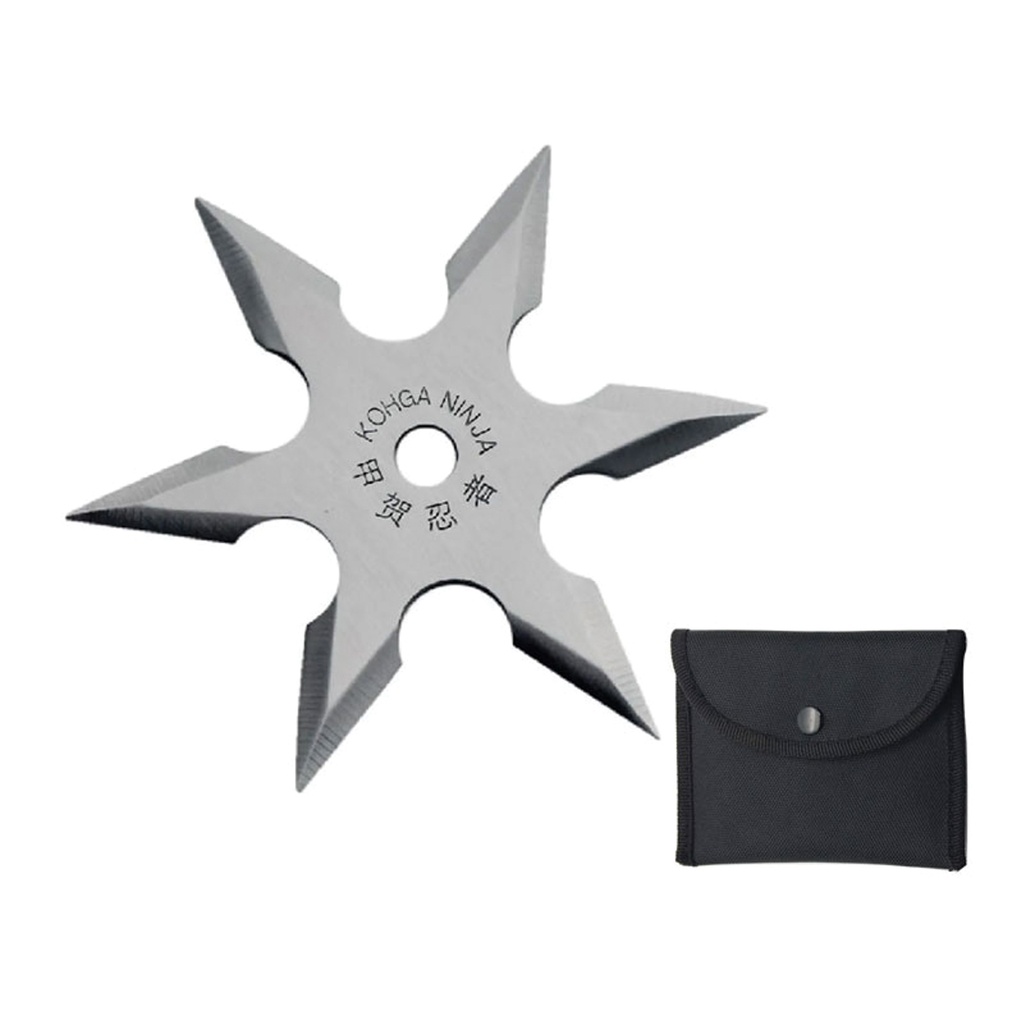
The Steady Orbit Precision Throwing Star - Silver is built for repeatable throws, not wall-hanger drama. Its 4-inch, six-point layout spreads weight evenly, so it leaves your fingers clean and tracks straight in the air. The satin silver finish slides from the hand without drag, while the center hole gives a reliable index point every throw. It ships with a black nylon pouch that actually protects the points, making this a practical choice for backyard practice, dojo drills, or budget-friendly retail displays.
What Makes a Throwing Star the “Best” for Practice?
With throwing stars, “best” has nothing to do with fantasy aesthetics and everything to do with repeatability. The best throwing star feels the same in your hand every time, leaves cleanly on release, and flies predictably enough that beginners can learn and intermediates can refine. The Steady Orbit Precision Throwing Star - Silver earns its place as a best budget practice star because its six-point symmetry, modest 4-inch diameter, and no-nonsense satin finish are all tuned toward consistent throws rather than spectacle.
Design and Balance: Why This Star Flies Predictably
This is a classic six-point ninja throwing star, but the geometry is more disciplined than decorative. Each arm is the same length, the bevels match, and the center cutout sits dead on the rotational axis. That matters more than most people realize—if one arm carries more mass or one bevel is noticeably different, the star will wobble instead of orbiting smoothly.
In hand, the weight distribution feels even across all six points. For new throwers, that means you can grip almost anywhere along the edge and still get a clean release. For more practiced users, the engraved center hub and circular hole provide a tactile index point so you can return to the same grip without looking.
Six Points for Forgiving Stick Rates
Six sharpened points make this one of the more forgiving layouts for training and casual use. Compared to three- or four-point stars, a six-point design gives you more angles that will hit tip-first and bite into a soft target. That doesn’t make sloppy throwing good technique, but it does shorten the learning curve and keeps practice sessions rewarding instead of frustrating.
4-Inch Diameter: Compact, Not Toy-Sized
At around 4 inches across, this star sits in the usable middle ground. It’s compact enough to carry in the included pouch without bulk, yet large enough to offer a confident grip surface for adult hands. Smaller stars can feel twitchy and hard to control; oversized pieces can fatigue your fingers quickly. This size suits backyard practice, dojo instruction, and light club use.
Material and Edge: Built for Training, Not Heavy Penetration
The Steady Orbit star uses a simple metal construction with sharpened points rather than fully ground, razor-like edges. That’s the correct choice for a best training or recreational throwing star. You get enough bite at the tips to stick in soft wood or dense foam, but the flat faces and moderate bevels don’t chew up your target as aggressively as a thin-edged knife would.
The satin silver finish isn’t just cosmetic. It smooths minor machining marks so the star slides from your fingers instead of grabbing skin or catching on rough spots. In practice, that translates into cleaner release and fewer flyers caused by the star hanging for a split second as you let go.
Honest Tradeoff: Not a Heavy-Duty Impact Tool
Because the focus is on balance and accessible pricing, this is not the best choice if your goal is maximum penetration into very hard targets or abusive, full-force impacts. It’s optimized for repetition on appropriate backstops, not for smashing into plywood or metal. For martial-arts drills, skill-building, and casual target sessions, it’s more than adequate. For extreme penetration tests, you’d move to thicker, heavier steel and live with more fatigue and higher cost.
Carry, Handling, and Real-World Use
Many throwing stars ship bare, which is fine for a display shelf but clumsy for real use. This one arrives with a compact black nylon pouch sized specifically to the 4-inch profile. The snap-closure flap fully covers the points, so you can drop the pouch into a range bag or training duffel without shredding everything around it.
On the range, the star’s flat profile makes it easy to stack multiples in the same pouch if you’re building a set. The minimal engraving around the center hole provides enough texture to grip when your hands are sweaty, but not so aggressive that it abrades your fingers after repeated throws.
Best Use Case: A Practical, Balanced Throwing Star for Training
If you’re looking for the best throwing star for basic practice and light martial-arts training, the Steady Orbit makes more sense than heavier, more aggressive pieces. Its balanced six-point layout rewards decent technique and forgives minor mistakes, which is exactly what you want when teaching or learning. It’s also inexpensive enough that you can buy several for class or club use without babying them.
What it is not: a hyper-specialized competition star tuned to an individual grip style, or a thick, brutal impact tool meant for destructive testing. Its strength is that most hands can pick it up, learn the motion, and start seeing sticks within a session.
Common Questions About the Best OTF Knives
What makes an OTF knife the best choice for EDC?
When people talk about the best OTF knife for everyday carry, they’re usually focused on three things: reliable double-action deployment, a blade steel that holds a working edge, and a slim profile that actually disappears in the pocket. A truly best OTF knife for EDC fires and retracts cleanly under stress, doesn’t develop blade play after moderate use, and carries comfortably enough that you don’t leave it at home. None of that matters if it feels like a novelty rather than a tool.
How does this OTF knife compare to a folding knife?
The best OTF knife designs trade the mechanical simplicity of a liner-lock or frame-lock folder for immediate, one-handed deployment in a straight line. Compared to a traditional folding knife, a well-built OTF offers faster access and typically better ambidextrous use. The tradeoff is more moving parts to maintain and, often, a thicker handle. For many users, the best OTF knife is the one that justifies that extra complexity with real-world speed and control, not just gadget appeal.
Who should choose this OTF knife?
The best OTF knife buyer is someone who will actually use the mechanism rather than just showing it off—think users who open and close their knife dozens of times a day. If you value rapid, repeatable deployment, work in gloves, or have limited dexterity, a well-executed OTF can be the best tool. If you mostly open packages at a desk and prefer a thinner profile, a standard folder may be a better fit.
Final Recommendation: The Best Throwing Star for Accessible, Repeatable Practice
If you’re looking for the best throwing star for everyday practice and skill-building, the Steady Orbit Precision Throwing Star - Silver is a smart, defensible choice. It balances evenly across six points, the 4-inch diameter suits most hands, and the satin finish plus center hole support a clean, consistent release. It’s honest about what it is: a practical, balanced training star with a protective pouch, not a fragile display piece or overbuilt impact tool. For instructors, new throwers, and anyone assembling a reliable practice set, this is the one that will actually see regular use.