Tactical Vector Balisong Utility Knife - Black Stainless
9 sold in last 24 hours
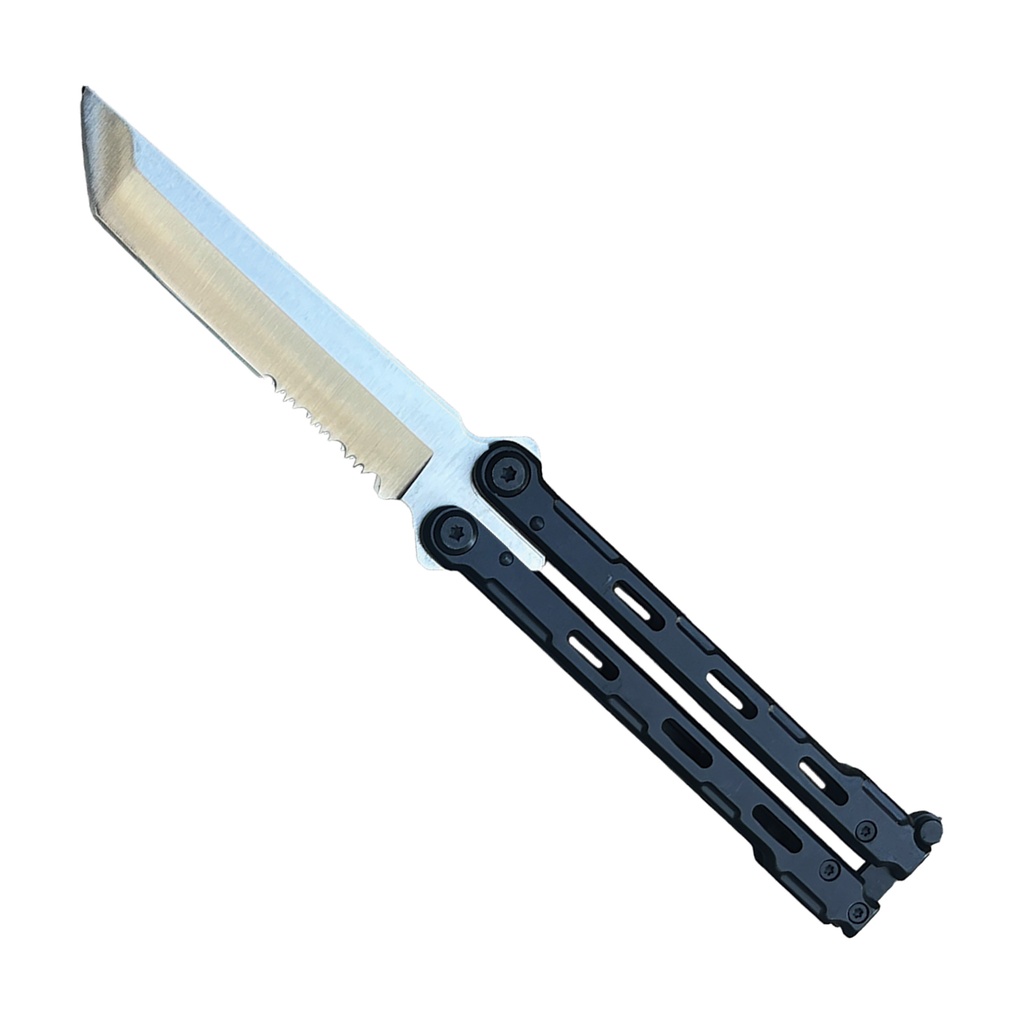
For buyers chasing the best OTF knife alternatives for everyday carry control, this Tactical Vector balisong earns its place. The 3.5-inch 440C tanto blade mixes a piercing tip with partial serrations that actually bite into rope and plastic. Skeletonized stainless handles keep the flip predictable instead of twitchy, and the T-latch stays out of the way once open. This is ideal for EDC users and shop owners who want a real cutter that also rewards clean technique, not a loose novelty.
How We Judge the Best OTF Knife Alternatives in a Balisong
When someone searches for the best OTF knife for everyday carry, what they usually want is fast, controlled access to a real working edge. This Tactical Vector Balisong Utility Knife - Black Stainless isn’t an OTF knife by mechanism, but it competes for the same pocket space. To earn a “best” spot as an OTF knife alternative, it has to prove three things: dependable deployment, a blade that actually cuts through daily tasks, and carry manners that don’t punish you for choosing a butterfly design.
This balisong leans into those criteria with a 3.5-inch 440C tanto blade, skeletonized stainless handles, and a straightforward T-latch. It’s built less like a trick toy and more like an affordable working knife that just happens to flip.
Why This Balisong Competes With the Best OTF Knife for EDC
OTF knives win on one thing: immediate deployment. But they trade that for complexity and higher cost. This knife offers a different equation: a simple, durable mechanism you can maintain yourself, plus a blade geometry tuned for real cutting. For the buyer comparing the best OTF knife to a balisong, this is the practical option that still feels technical in hand.
Mechanism: Simple, Serviceable, and Predictable
The dual-handle butterfly mechanism here isn’t about flashy tricks, it’s about repeatable opening. The stainless handles pivot cleanly on visible hardware, and the T-latch locks things down in the open and closed positions. There’s no internal spring, no track to clog with lint, and no button to fail—just pins, pivots, and gravity. If you’ve ever had an OTF knife choke on pocket debris, that simplicity is a real advantage.
In use, the knife feels calm rather than hyperactive. The skeletonization lightens the handles enough to keep them from feeling like metal clubs, but not so much that the flip becomes unpredictable. That’s the difference between a flipper you can learn on and one that punishes every mistake.
Blade Geometry: Tanto Tip With Real-World Serrations
The 3.5-inch American tanto blade gives you two distinct working zones. The primary straight edge handles push cuts and box duty; the reinforced tip bites into cardboard corners and blister packs without feeling fragile. The partial serrations are aggressive enough to chew through nylon strap and light rope without stalling.
440C stainless is an honest mid-tier choice here. It won’t hold an edge like premium powdered steels, but it shrugs off rust in pocket carry and sharpens quickly on basic stones. For a knife at this price point, being able to restore a working edge in minutes matters more than exotic metallurgy.
Best OTF Knife Alternative for Budget Everyday Carry
If you’re looking at the best OTF knife lists but flinch at paying premium-automatic prices, this balisong deserves a look. It gives you a modern tactical profile—tanto tip, partial serrations, blacked-out handle—without the mechanical overhead of a double-action OTF. You trade one-handed push-button deployment for a learnable opening sequence and much simpler maintenance.
Carry and Handling: Practical, Not Pocket-Art
With a 5-inch closed length and an overall length of 8.25 inches, this is full-size but still pocket-manageable. The low-profile clip rides discreetly; it doesn’t scream for attention the way some oversized OTF knife clips do. The matte black stainless handles don’t advertise scratches, and the elongated oval cutouts break up the slab feeling in hand.
Weight-wise, it sits in that middle zone where you always know it’s there but it never drags. If you’re used to the slim feel of the best OTF knife for EDC models, this is bulkier in pocket, but not so much that you’ll leave it at home.
Tradeoffs: Where an OTF Still Wins
Honesty matters: if you truly need instant, one-handed deployment in gloves or under stress, a well-made double-action OTF knife still wins. A balisong requires practice, attention, and bare hands to run safely. It’s also not the best option in environments where knife laws treat butterfly designs more strictly than standard folders.
Where this knife pulls ahead is value and simplicity. There’s no internal carriage to bend, no spring tension to tune, and no specialized tools required. For everyday utility cutting—breaking down boxes, trimming cord, opening packages—it does the same work an OTF would, with fewer moving parts to fail.
What Makes a Knife Earn “Best” Status in This Role
To honestly position this as an alternative to the best OTF knife for everyday carry, it has to meet clear standards:
- Reliable deployment: The pivots and T-latch lockup remain consistent after repeated openings; there’s no creeping play that makes the blade feel uncertain.
- Usable edge profile: The tanto and serration pairing actually solves common EDC tasks—fine tip work plus rough cutting—without gimmicks.
- Maintainable construction: Visible hardware and stainless throughout make cleaning and tightening straightforward, especially compared to sealed OTF internals.
- Carry discipline: Closed length, clip placement, and matte finishes make it realistic to carry daily instead of relegating it to a drawer.
- Price-to-performance balance: At its cost, you can stock it, train with it, or carry it hard without babying it like a collector-grade automatic.
Common Questions About the Best OTF Knives
What makes an OTF knife the best choice for EDC?
The best OTF knife for EDC usually offers fast, one-handed deployment, a secure lock, and a blade profile that handles everyday cutting without excess bulk. A good OTF combines a reliable internal mechanism, decent steel, and a slim profile that disappears in pocket. Where this balisong differs is philosophy: you gain mechanical simplicity and training-friendly handling at the cost of that instant, push-button deployment.
How does this OTF knife alternative compare to a typical folding knife?
Compared to a standard liner-lock or frame-lock folder, this butterfly knife is more deliberate to open but more balanced in hand once deployed. You get two handle arms to wrap around, which can feel more secure on heavier cuts. Against a basic folder, it also spreads wear across two pivot points instead of one. However, it is longer in pocket and demands more practice to use safely—something a conventional folder or even the best OTF knife for beginners doesn’t require.
Who should choose this OTF knife alternative?
This knife suits three clear buyers. First, enthusiasts who want a practical balisong they’re not afraid to actually cut with, not just flip. Second, EDC users who like the tactical look of the best OTF knife models but prefer simpler mechanics and lower replacement cost. Third, retailers and resellers who need a reliable, modern-looking butterfly knife that converts casual interest into repeat sales because it feels substantial and cuts well out of the box.
If you’re looking for the best OTF knife alternative for budget-conscious everyday carry, this Tactical Vector balisong hits the mark because it delivers a useful tanto-serrated 440C blade, stable stainless handles, and honest, low-maintenance construction that can take daily use without demanding premium-automatic money.
| Blade Length (inches) | 3.5 |
| Overall Length (inches) | 8.25 |
| Closed Length (inches) | 5 |
| Blade Color | Silver |
| Blade Finish | Matte |
| Blade Style | American Tanto |
| Blade Edge | Partial-Serrated |
| Blade Material | 440C Stainless Steel |
| Handle Finish | Matte |
| Handle Material | Stainless Steel |
| Theme | None |
| Latch Type | T-latch |
| Is Trainer | No |