Talon Flow ArchAngel Out-the-Front Karambit - Carbon Fiber
11 sold in last 24 hours
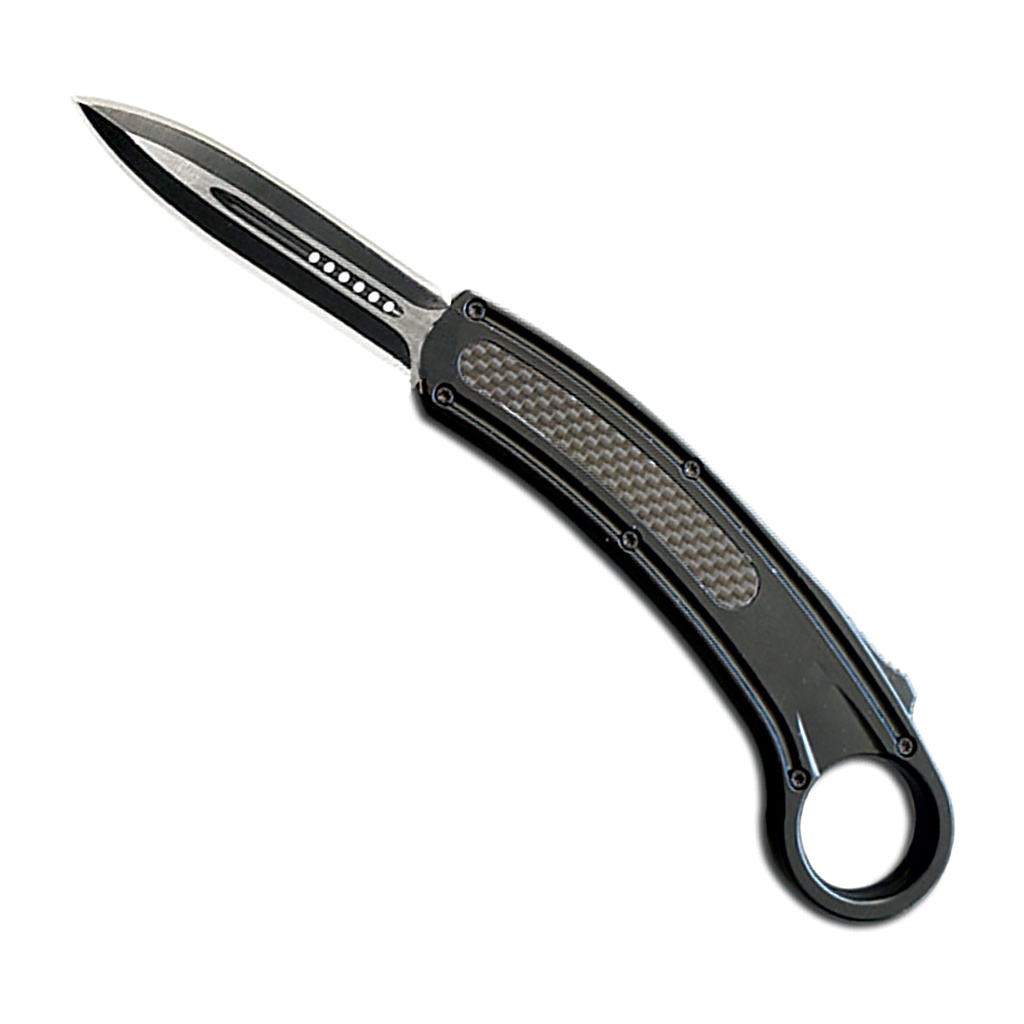
For buyers chasing the best OTF knife for defensive carry, this ArchAngel karambit makes a strong, specific case. The out-the-bottom deployment drops a double-edge talon into a fighting-forward grip without needing to adjust your hand. The ring lock and curved handle keep the blade indexed under stress, while the carbon fiber inlay adds traction without bulk. It’s not a general-purpose box cutter; it’s a purpose-built tactical OTF for users who prioritize grip security and instinctive edge orientation over everyday utility.
What Makes the Best OTF Knife More Than a Gimmick
When someone searches for the best OTF knife, they’re usually not looking for a desk toy. They want fast, reliable deployment, a blade that actually suits the job, and a handle that still works when adrenaline ruins your fine motor skills. With the ArchAngel out-the-bottom karambit, the design leans hard into that reality: this is a purpose-built defensive OTF, not a generalist box cutter.
To call any knife the best OTF knife for a specific role, it has to clear a few bars: a mechanism you can trust, ergonomics that hold up under stress, a blade geometry that matches the intended use, and honest carry tradeoffs. This one earns its place on a best list for defensive use, but it’s not pretending to be a do-everything everyday carry.
Why This Karambit Competes for “Best OTF Knife” in Defensive Roles
Most people typing in “best OTF knife” picture a straight-handled, clip-equipped, double-action auto. The ArchAngel breaks that mold by combining a fixed-karambit grip profile with an out-the-bottom deployment. The result: once your finger is in the ring and your thumb finds the slide, the blade appears exactly where your hand already wants it, in a forward, edge-aligned grip.
This is where it legitimately competes as one of the best OTF knife designs for defensive carry. The ring and curve lock your hand into a single, repeatable orientation. Under stress, you’re not wondering which way the edge is facing or whether the handle has rotated. That’s not an abstract benefit – it’s the difference between a controlled cut and losing your own index finger when things get messy.
Deployment: Out-the-Bottom, Fighting-Forward
The out-the-bottom slot positions the blade to emerge in line with the ring and curve, putting the talon out front instead of above your knuckles. On a straight OTF, you still have to adjust your grip slightly after the blade opens. Here, the motion is one continuous arc: grip, press, engage.
Is it the best OTF knife mechanism for everyday tasks? No. The out-the-bottom path makes it awkward for casual slicing on a flat surface. But for a user who wants an OTF that comes alive in a combative grip, this layout makes more sense than a standard top-eject design.
Double-Edge Talon Blade: Purpose-Built, Not Utility-Optimized
The slim, silver talon blade is double-edged with a plain grind. That matters. A double-edge profile increases cutting options in tight, rotational movements, which is what a karambit is designed for. The fuller and lightening holes shave a bit of weight and keep the blade responsive, though they also mean you’re not buying this knife for heavy prying or abusive chores.
From a pure EDC perspective, the best OTF knife usually has a single-edge drop point or tanto you can choke up on for box duty, food prep, and cable stripping. This blade doesn’t excel there; it excels at controlled, arcing cuts with multiple usable edges in confined space. If you’re honest about that, it’s a feature, not a compromise.
The Best OTF Knife for Instinctive Ring-Grip Control
If you’ve ever tried to use a straight-handled OTF under stress, you know how easy it is to lose index of where the edge lives. The ArchAngel’s curved handle, pronounced ring, and carbon fiber-backed panels address that directly. It’s chasing "best OTF knife" not by being more aggressive looking, but by making the grip nearly idiot-proof when your hands are shaking.
Handle, Ring, and Carbon Fiber Inlay
The matte black frame keeps the profile low-visibility, while the carbon fiber inlay adds both texture and a slight contour break so your fingers know where they are without looking. The ring anchor lets you lock in with your smallest finger or index, depending on how you train, and that physical anchor dramatically reduces the chance of the knife being stripped from your hand.
There’s a tradeoff: there’s no pocket clip. That’s a big mark against it as the best OTF knife for everyday carry, because pocket access will never be as clean as a clipped, straight-bodied auto. You’ll likely carry this in a bag, belt pouch, or waistband. If you want an OTF that disappears on a pocket seam, this isn’t it. If you want the most secure in-hand feel once it’s drawn, that absence of a clip actually keeps the ring area clean and snag-free.
Carry Reality: Not a Traditional EDC OTF
In daily use, the curvature and ring mean it occupies more space than a typical rectangular OTF knife. You’re trading in-pocket neatness for in-hand control. For someone looking for the best OTF knife for everyday cutting tasks, that’s a poor trade. For a user who cares more about retention in a worst-case scenario, it’s a fair bargain.
Where This Knife Is Not the Best Choice
Honesty is the only way "best OTF knife" lists stay useful. This ArchAngel karambit is not the best OTF knife for everyday carry in the usual sense. The double-edge talon makes precision utility work fiddly, the lack of pocket clip complicates quick but discreet access, and the aggressive geometry is overkill for people whose hardest task is opening deliveries.
It’s also not the best OTF knife if you’re chasing premium steel, extended edge life, or heavy-use durability. At this price point, you’re buying concept and deployment style more than metallurgy. Treat it as a defensive tool and light cutter, not a pry bar or camp knife, and it holds up well for what it is.
Common Questions About the Best OTF Knives
What makes an OTF knife the best choice for EDC?
The best OTF knife for everyday carry usually checks a different set of boxes than this karambit. For true EDC, you want a reliable double-action mechanism, a single-edge blade you can sharpen easily, a solid pocket clip for consistent carry position, and a handle that feels neutral in multiple grips. Straight-bodied OTFs with drop points or tantos win there because they balance cutting performance, comfort, and low-profile carry. The ArchAngel only overlaps that category partially; it’s optimized for grip retention and fast, instinctive deployment rather than all-day utility.
How does this OTF knife compare to a standard straight OTF?
Compared to a standard rectangular OTF knife, the ArchAngel karambit trades pocket manners for ring-lock control. A typical best OTF knife option will draw flat, ride on a clip, and handle like a small fixed blade once deployed. This one draws more like a dedicated defensive tool: you commit a bit more space on your body or in your kit in exchange for a grip that feels welded to your hand. If you mostly open packages, the straight OTF wins. If you train with ringed blades and value retention, this design makes more sense.
Who should choose this OTF knife?
This belongs with users who deliberately want a ringed, curved, out-the-front knife as part of a defensive or training setup. If your search for the best OTF knife leans toward self-defense, martial arts, or purpose-built tactical carry, the ArchAngel’s out-the-bottom deployment and karambit geometry give you exactly that. If you’re a casual buyer who wants a general-purpose utility OTF to ride in your jeans pocket, you’re better served by a more neutral, clip-equipped design with a single-edge blade.
Final Verdict: Best OTF Knife for Ringed Defensive Deployment
If you're looking for the best OTF knife for ring-grip defensive carry, this ArchAngel karambit is it — because its entire design prioritizes instinctive edge orientation and hand retention over generic utility convenience. The out-the-bottom deployment delivers the double-edge talon into a fighting-forward grip without post-launch juggling, the curved handle and ring lock your hand into a single, repeatable index, and the carbon fiber inlay adds traction without turning the handle into a cheese grater. It’s not the best OTF knife for everyday carry chores, and it doesn’t pretend to be. For the buyer who understands that tradeoff and wants a purpose-built tactical OTF at an accessible price, it earns its spot.
| Blade Color | Silver |
| Blade Finish | Matte |
| Blade Style | Talon |
| Blade Edge | Plain |
| Handle Material | Carbon Fiber |
| Theme | Carbon Fiber |
| Pocket Clip | No |