Trail Sentry Sawback Hunting Knife - Gray Rubber Grip
8 sold in last 24 hours
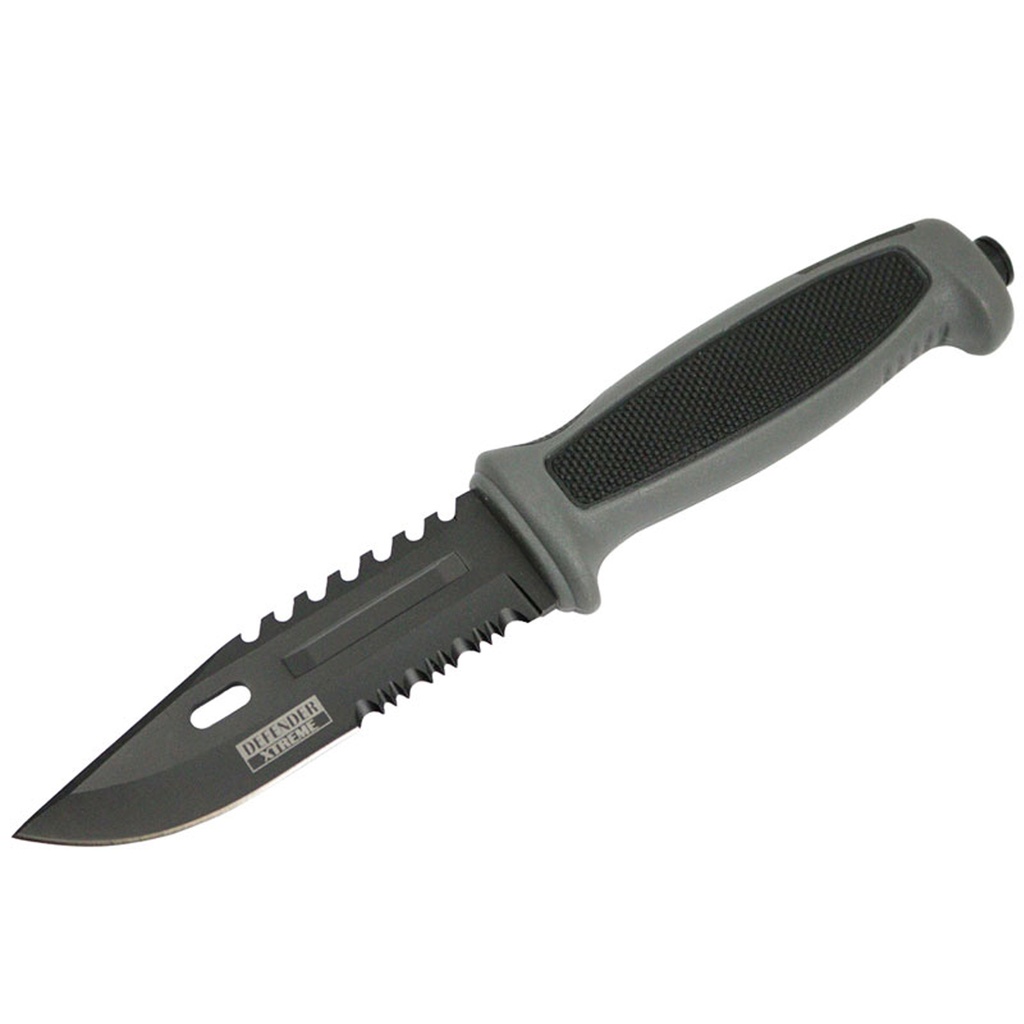
This isn’t a showpiece; it’s a budget hunting and camp knife built to get knocked around. The 4.5-inch black drop point blade combines a partial serrated edge with a sawback spine, so one tool can handle light cutting, notching, and basic camp tasks. The gray rubber grip stays usable when wet and gloved, and the full 9.5-inch length gives decent leverage without feeling clumsy. It’s best suited as an affordable backup hunting or truck knife you won’t baby.
What Makes a Fixed Blade Earn “Best” Status at This Price
When you’re evaluating a budget hunting and survival-style fixed blade, “best” doesn’t mean heirloom quality. It means a knife that can live in a truck, tackle box, or daypack, do real work, and not make you angry when it eventually gets lost or abused. At this end of the market, the best fixed blade is the one that cuts reliably, feels secure in the hand, and handles a mix of hunting and camp chores without pretending to be a high-end survival tool.
The Trail Sentry Sawback Hunting Knife - Gray Rubber Grip fits that role: an inexpensive, purpose-built fixed blade that leans tactical in looks but is realistically a field and camp utility knife. It’s not a one-tool wilderness solution, but as a backup hunting knife or rough-use beater, it earns its place.
Blade Design: Sawback Utility, Not Fantasy
The 4.5-inch black drop point blade is where most of the work happens, and the design choices here are what keep this knife practical instead of purely decorative.
Drop Point Profile for Realistic Hunting Tasks
The drop point geometry gives you a controllable tip for light game chores and general cutting, even if the steel is basic carbon or stainless of unspecified grade. On a budget fixed blade, profile matters more than steel pedigree, because you can always resharpen. Here, the belly of the blade is broad enough for slicing and simple skinning, and the point is stout rather than needle-fine, which suits camp tasks like light prying or notching.
Sawback and Partial Serrations: Where They Actually Help
The spine sawback and partial serrations make this look like a tactical survival knife, but in use they’re best treated as rough-cutting aids. The serrations near the handle will chew through cord, light rope, and small, fibrous branches faster than a plain edge when the blade is dull. The sawback is suitable for aggressive notching or scoring green wood, but it’s not a replacement for a real saw. If you go in expecting light utility rather than bushcraft heroics, it delivers appropriately for its price.
Handle and Control: Why the Rubber Grip Matters
On budget knives, the handle often ruins an otherwise workable blade. Here, the gray rubber handle is actually the best part of the package and the main reason this knife is usable as a field beater.
Rubberized Grip for Wet and Gloved Use
The 5-inch handle is molded rubber with black textured inlays, giving you friction in bare hands and enough contour that it doesn’t spin in a gloved grip. In cold or wet hunting conditions, this matters more than fancy materials. The integrated guard keeps your fingers from sliding forward onto the edge when you’re pushing through tougher cuts, and the overall 9.5-inch length provides decent leverage without feeling like a machete.
Flat Pommel and General-Purpose Duty
The flat pommel with a protruding end cap is more about durability than specialized use. You can tap it lightly to drive tent stakes or nudge a wedge, but it’s not a dedicated hammer face. Think of this as the butt of a tool you won’t mind abusing around camp rather than a precision striking surface.
Best Use Case: A Budget Hunting and Camp Backup Knife
This knife is not the best choice for a primary survival blade or for hunters who process multiple animals every season. The unbranded steel, sawback, and aggressive styling put it squarely in the budget tactical hunting category. Where it genuinely earns a “best” label is as a low-cost backup fixed blade you can stage and forget.
It’s best used as a glove-box or truck knife, a loaner for beginners who might be rough on gear, or a camp utility blade that handles cutting cord, trimming small branches, and basic game prep when you don’t want to risk your nicer knives. If it gets lost or abused, you’ve lost a tool, not an investment piece.
Real-World Tradeoffs: What This Knife Is Not
Honest evaluation means being clear about limits. This is a budget fixed blade, and that comes with tradeoffs.
- Steel Unknowns: The unspecified steel and matte black coating suggest an entry-level carbon or stainless. Expect to sharpen more often, not less. With a simple profile, that’s manageable, but edge holding will not compete with higher-end hunting knives.
- Sawback Limitations: The sawback is serviceable for shallow notching and rough cutting but will clog quickly in dense material. It’s an auxiliary feature, not a primary tool.
- Not a Dedicated Skinner: The partial serrations and tactical styling mean it won’t glide through long skinning cuts as cleanly as a thin, plain-edge hunting knife.
If you understand these constraints and intend to use it accordingly—as a secondary or backup hunting knife—the performance is aligned with expectations.
Common Questions About the Best OTF Knives
What makes an OTF knife the best choice for EDC?
For everyday carry, the best OTF knife combines reliable double-action deployment, a slim profile, and a blade that’s sized for real tasks rather than spectacle. A top-tier OTF knife for EDC fires consistently one-handed, retracts just as cleanly, and rides flat in the pocket so you actually carry it. Steel quality matters, but so does a secure, non-abrasive pocket clip and a mechanism that tolerates lint and dirt without constant maintenance.
How does this fixed blade compare to the best OTF knife for daily use?
This Trail Sentry Sawback Hunting Knife is a fixed blade, so it occupies a different role than even the best OTF knife for EDC. An OTF excels at quick, discreet one-handed access in urban or light-duty environments. This fixed blade is bulkier, better suited to outdoor, hunting, or camp work where a sheath knife makes sense and local laws are less restrictive. If you need a pocket-friendly daily cutter, a compact OTF or folding knife is the right call; if you need a disposable-leaning, hard-use camp knife, this fixed blade makes more sense.
Who should choose this knife over the best OTF knife?
You should choose this knife if you spend more time in trucks, campsites, and hunting blinds than in offices, and you want an inexpensive fixed blade you won’t hesitate to abuse. A best-in-class OTF knife is ideal for controlled EDC tasks, packaging, and light utility work. This Trail Sentry is for the buyer who wants a glove-box or gear-bin fixed blade for occasional hunts, bonfire prep, and general rough cutting, and who understands it’s a budget tool, not a precision everyday carry piece.
If You’re Looking for the Best Budget Backup Hunting Knife, This Is It
If you’re looking for the best budget fixed blade to leave in your truck or pack as a backup on casual hunts, this is it—because the blade geometry, rubber grip, and mixed-edge design give you enough capability to handle real camp and light hunting tasks without asking you to care if it gets lost or abused. It’s honest about what it is: a rough-duty, tactical-styled hunting knife that earns its keep through utility, not prestige.
| Blade Length (inches) | 4.5 |
| Overall Length (inches) | 9.5 |
| Blade Color | Black |
| Blade Finish | Matte |
| Blade Style | Drop Point |
| Blade Edge | Partial-Serrated |
| Blade Material | Steel |
| Handle Finish | Matte |
| Handle Material | Rubber |
| Theme | Tactical |
| Handle Length (inches) | 5 |
| Pommel/Butt Cap | Flat pommel |