Trail Signal Field-Ready Hunting Knife - Red & Blue Pakkawood
13 sold in last 24 hours
For a budget fixed blade that still feels like a real field tool, the Trail Signal Field-Ready Hunting Knife earns its keep. The 3.75-inch stainless clip point is sized right for game processing and camp chores, and full-tang construction means it won’t shrug off hard use. Finger grooves and polished red-and-blue pakkawood give a secure, visible grip, while the stitched leather belt sheath carries quietly. It’s best for hunters and campers who want a dependable, easy-to-spot knife they won’t baby.
What Makes a Fixed Blade Earn “Best” Status in the Field?
When I call a budget hunting fixed blade “best” for a certain role, I’m not grading it against custom steel or premium brands. I’m asking one question: does it behave like a real field tool, or like a novelty? The Trail Signal Field-Ready Hunting Knife lands on the right side of that line by getting three fundamentals right: blade geometry that actually cuts, a handle you can work with for more than five minutes, and carry that doesn’t annoy you into leaving it at home.
This isn’t the best OTF knife or even the best tactical option; it’s a compact fixed blade built for hunting and camp use. Judged on that scale—especially at its price—its combination of full-tang build, leather belt sheath, and high-visibility pakkawood handle earns it a place as one of the best fixed hunting knives for buyers who want real utility without paying collector money.
Blade and Steel: Sized for Game, Honest About Edge Performance
The 3.75-inch stainless clip point is the heart of why this works as a field knife. Sub‑4 inches is a sweet spot for deer-sized game: long enough to open the cavity and work around joints, short enough to control the tip. The clip point’s swedge gives you a narrow, precise tip for detail cuts—think caping, working along bone, and trimming connective tissue.
Edge Holding vs. Ease of Sharpening
The stainless steel here is a workmanlike choice rather than a bragging-rights alloy. It will not compete with high-end super steels on edge retention, and that’s the tradeoff. In exchange, you get a blade that sharpens quickly on basic stones and is far more forgiving of neglect. For a glovebox, camp, or loaner knife, that’s a reasonable compromise.
In use, expect to touch up the edge after breaking down an animal or a stretch of dirty cardboard. If your definition of the best hunting knife is “stays razor sharp for a whole season,” this isn’t that. If your definition is “sharpens easily in camp and doesn’t rust at the sight of moisture,” it’s in the running.
Clip Point Geometry That Actually Bites
The factory grind is a straightforward working edge, not a delicate slicer. That matches the intended use: game processing, camp food, and light utility. The satin finish helps resist corrosion and makes sticky organic residue easier to clean than on coarse beadblasts or coated blades.
Handle and Ergonomics: High-Visibility Comfort, Not Tactical Stealth
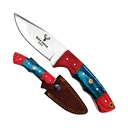
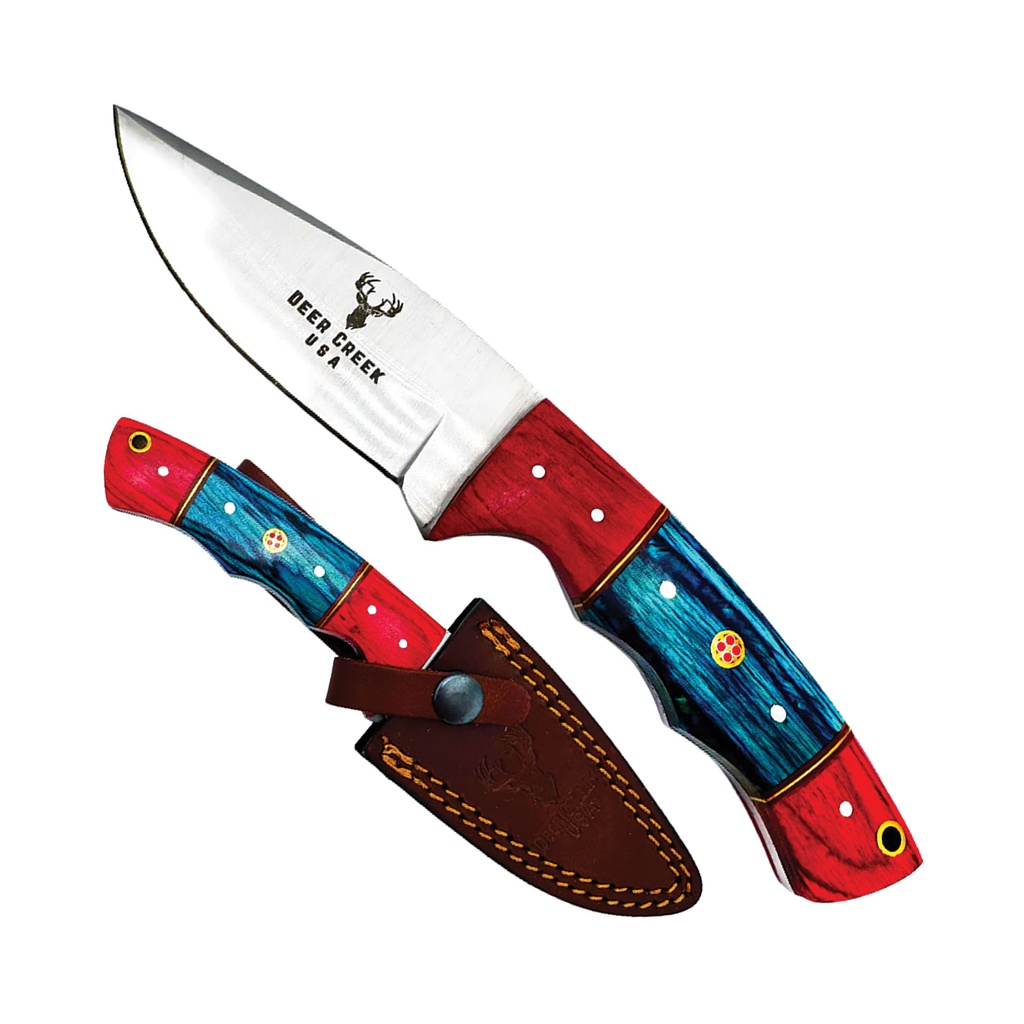
The red and blue pakkawood handle is the first thing you notice, and the color isn’t just decoration—it’s a genuine usability feature. In the field or around camp, a bright handle is simply harder to misplace. If you’ve ever spent ten minutes kicking leaves looking for a dropped green or black knife, you already know why this matters.
Finger Grooves and Control
The handle runs 4.25 inches with pronounced finger grooves. These lock the hand in securely when you’re pulling through tough cuts or working with wet hands. The tradeoff is that if your hands are very large or very small, those grooves may dictate your grip more than you’d like. It’s best for medium to large hands who use a standard hammer or saber grip.
Pakkawood—stabilized, laminated wood—gives you the warmth of wood with better resistance to moisture and swelling. The polished finish isn’t as grippy as rubber, but the contouring does most of the work. It feels more like a traditional hunting knife than a modern tactical tool, and that’s intentional.
Full Tang and Decorative Pins
You can see the full tang running the length of the handle, which is non-negotiable for a hunting fixed blade you might baton lightly through small branches or twist while freeing a stuck cut. Mosaic and white pins are mostly aesthetic, but they do signal that someone cared about assembly rather than just slapping scales on a blank.
A lanyard hole at the butt, ringed in yellow, makes adding a wrist lanyard or brightly colored fob straightforward—useful insurance when working over water or steep ground.
Carry and Use: Best as a Belt-Riding Camp and Hunting Knife
The included brown leather sheath is what upgrades this from a “drawer knife” to something you’ll actually carry. A simple belt loop and snap strap hold the knife close to the body without rattling. Leather also rides more comfortably under a jacket or pack waist belt than many stiff synthetics.
At 8 inches overall and about 9 ounces, this is not a featherweight ultralight tool. That extra mass makes it feel planted in the hand and stable when cutting, but you’ll notice it more on a minimalist hiking belt. That’s why I’d call it the best fixed blade here for day hunts, truck kits, and camp duty, not for ounce-counters on a thru-hike.
Where It Excels—and Where It Doesn’t
- Best for: budget-conscious hunters, car campers, and general outdoors users who want a dependable belt knife with traditional looks and easy sharpening.
- Not ideal for: tactical use, heavy survival batoning, or users who demand high-end steel and ultralight carry.
If you’re cross-shopping this against the best OTF knife for everyday carry, recognize you’re choosing a different tool entirely. An OTF wins for pocket convenience and one-handed deployment; this fixed blade wins anytime controlled cutting power, cleaning ease, and strength matter more than discreet carry.
Value: Honest Working Knife, Priced to Be Used
The most compelling argument for this knife is that you don’t have to baby it. For the cost, you’re getting a real leather sheath, full-tang construction, and a handle that won’t disappear visually in the brush. Those are the traits that make a fixed hunting knife one of the best choices for truck, tackle box, or loaner duty, even if you also own more expensive blades.
It’s not a collector’s showpiece, and it doesn’t pretend to be. It’s the knife you hand a buddy on opening weekend without worrying whether you’ll get it back pristine. That matters more, in day-to-day use, than exotic alloys you’re afraid to scratch.
Common Questions About the Best OTF Knives
What makes an OTF knife the best choice for EDC?
When people search for the best OTF knife for EDC, they’re usually weighing three things: how fast and reliably it deploys, how safely it carries, and how the blade steel holds up to daily cutting. A good OTF offers secure, closed carry in the pocket, true one-handed open and close, and a blade length in the 2.5–3.5 inch range with mid-tier or better stainless steel. That makes it convenient for boxes, packaging, and quick utility cuts. By contrast, a compact fixed blade like the Trail Signal is best when you value strength and cleaning ease over pocket convenience.
How does this hunting knife compare to the best OTF knife options?
Compared to the best OTF knife for everyday carry, the Trail Signal trades speed for strength. There’s no mechanism to fail, no springs to foul, and no sliding track to clean—just a solid full-tang blade you can wash thoroughly after game processing. It’s slower to deploy and requires a sheath on your belt, but it’s safer to clean, stronger under twist loads, and easier to control in heavy cuts. If your primary use is urban EDC, an OTF probably suits you better; if it’s field dressing and camp chores, this fixed blade is the more rational choice.
Who should choose this hunting knife?
This knife makes the most sense for hunters, car campers, and outdoorsy folks who want a low-cost, full-tang fixed blade that still behaves like proper gear. It’s for the person who keeps a knife in the truck year-round, wants a belt knife for the occasional weekend hunt, or needs a backup camp knife that won’t be a tragedy if it’s lost. If you’re chasing the single best OTF knife for everyday carry, look elsewhere; if you’re building a basic field kit on a budget, this belongs on your shortlist.
If you’re looking for the best fixed hunting knife for budget-conscious field carry, this is it—because it combines a full-tang 3.75-inch clip point, high-visibility pakkawood handle, and real leather belt sheath into a package you won’t hesitate to use hard and sharpen often.
| Blade Length (inches) | 3.75 |
| Overall Length (inches) | 8 |
| Weight (oz.) | 9 |
| Blade Color | Silver |
| Blade Finish | Satin |
| Blade Style | Clip Point |
| Blade Edge | Plain |
| Blade Material | Stainless Steel |
| Handle Finish | Polished |
| Handle Material | Pakkawood |
| Theme | None |
| Handle Length (inches) | 4.25 |
| Tang Type | Full |
| Pommel/Butt Cap | Lanyard Hole |
| Carry Method | Belt Loop |
| Sheath/Holster | Leather Sheath |