
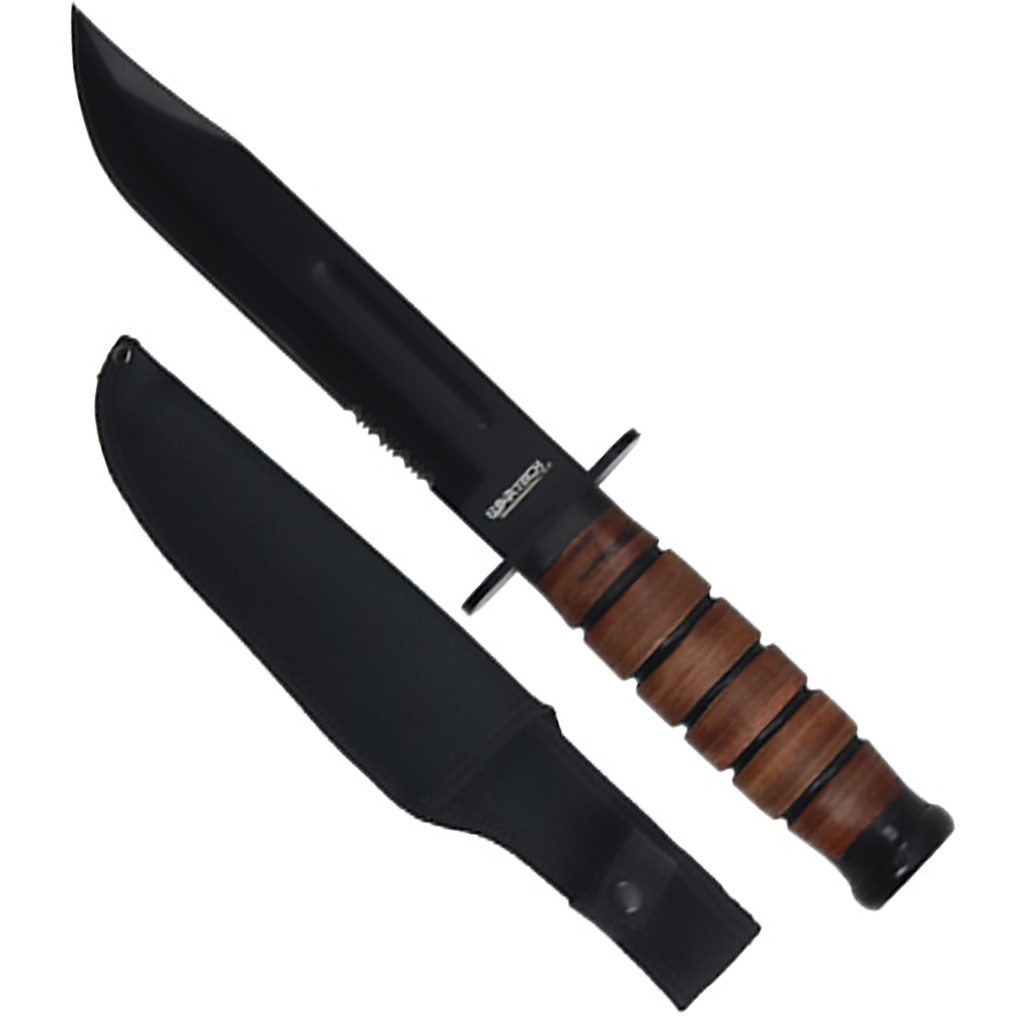


Trailguard Tactical Tracker Fixed Knife - Brown Leather
9 sold in last 24 hours
This isn’t a wall-hanger; it’s a working trail knife. The Trailguard Tactical Tracker Fixed Knife – Brown Leather pairs a 7-inch black clip-point blade with partial serrations and a full tang for real camp and survival use. The stacked leather handle fills the hand better than most plastic grips in this price range, while the double guard keeps your fingers off the edge during heavy cuts. Paired with a nylon belt sheath, it’s a practical choice for hikers and campers who want a rugged beater they won’t baby.
What Actually Makes the Best OTF Knife for Real-World Use?
Before we talk about why this blade belongs in a serious kit, let’s clear something up: this is not an OTF knife. It’s a full-tang fixed blade designed for trail, camp, and basic survival work. That matters, because the criteria for the best OTF knife — fast one-handed deployment, pocket carry, precise mechanism — are different from what makes a reliable fixed blade. Here, strength, grip, and cut performance under abuse take priority over clever opening systems.
So while search traffic chases the "best OTF knife for EDC," a lot of users actually need a dependable fixed blade on their belt when they’re off pavement. That’s where the Trailguard Tactical Tracker Fixed Knife - Brown Leather fits in: as a budget-friendly field knife that behaves like the sturdy, no-nonsense tool you strap on when a folder just won’t cut it.
Blade and Build: Why This Fixed Blade Beats a Cheap OTF Outdoors
The heart of this knife is a 7-inch black clip-point blade with a matte finish and partial serrations. It’s full tang — the steel runs all the way through the stacked leather handle — which is the single biggest structural advantage a fixed blade has over even the best double action OTF knife. There’s no internal track, no sliding chassis, nothing to wiggle loose when you baton, pry lightly, or twist the blade out of a cut.
Clip-Point Profile with Partial Serrations
The clip point gives you a fine tip for detail work like game processing or notching, while the long straight belly handles carving and food prep better than most aggressive tactical shapes. The partial serrations, positioned near the handle on the spine-side of the blade, are there for one job: sawing through tough material when a plain edge binds. Think nylon webbing, fibrous rope, or small branches too stubborn for a clean slice.
Full Tang and Guard: Confidence Under Load
On a fixed field knife, you feel flex and weakness immediately. Here, the full tang and steel double guard mean you can choke up and push without wondering what’s happening inside a handle cavity. The guard is sized like the old military classics: big enough to stop your hand in a slip, not so big that it catches on gear. That alone puts it ahead of many budget "tactical" knives that rely on shallow finger grooves instead of a real guard.
Handle, Grip, and Carry: Where It Wins vs. Pocket OTFs
For everyday urban carry, the best OTF knife for EDC is slim, light, and disappears in the pocket. This knife is none of those things, and that’s exactly why it works on a belt.
Stacked Leather Handle with Rounded Pommel
The stacked leather rings create a warm, slightly textured grip that behaves better than slick polymer when your hands are cold or damp. At 5 inches, the handle gives a full four-finger hold even with gloves. The rounded pommel with a slight flare helps anchor the knife in your palm for chopping and heavy pull cuts, and prevents the knife from slipping out if you’re swinging in a clearing or shelter-building role.
Nylon Sheath and Belt Carry Reality
The included nylon sheath is basic but functional: belt loop, snap closure, and a profile that keeps the knife reasonably close to the body. It’s not a high-end molded rig, but it does the core job — secure, consistent access on your hip — better than trying to force even the best OTF knife into a role it’s not built for, like batoning kindling or cutting through brush.
Best For: When a Fixed Blade Beats the Best OTF Knife
This knife earns its place not by out-EDC’ing a premium OTF, but by being a sensible choice when you actually need a field knife. If you’re looking for the best OTF knife for everyday carry in an office, this is the wrong tool. If you want something to live in a pack, on a belt, or in a truck kit for camping and light survival, it becomes a defensible pick.
The 12-inch overall length and 7-inch blade are overkill for most pocket tasks, but they’re appropriate when you’re splitting small kindling, trimming branches, or processing game. The blacked-out blade and tactical styling will appeal to buyers who like military-inspired gear, but in use it behaves like exactly what it looks like: an honest, affordable trail and camp knife.
Tradeoffs: Where This Knife Is Not the Best Choice
Honest evaluation means admitting where this design falls short. Compared to a dedicated EDC folder or the best OTF knife for EDC, this fixed blade is:
- Too large for discreet carry: It’s a belt knife, not a pocket tool.
- Less refined in steel and fit: At this price, you’re not getting premium stainless or boutique heat treat; expect a basic working edge, not an edge-retention champion.
- Single-purpose carry: You’ll carry this when you anticipate outdoor work, not every day in town.
Those tradeoffs are acceptable — and even desirable — if you’re buying a knife to live in a camping bin, truck, or hiking kit. They are not acceptable if your priority is urban EDC convenience, one-handed deployment in tight spaces, or minimal visual footprint. In those scenarios, a well-built OTF or compact folder is the better tool.
Common Questions About the Best OTF Knives
What makes an OTF knife the best choice for EDC?
The best OTF knife for EDC does three things well: it deploys reliably with one hand, it carries slim and light enough that you don’t resent it in your pocket, and its mechanism tolerates lint and daily grime without misfires. Good steel and ergonomics matter, but if an OTF’s action is finicky or the handle too bulky, a simpler folder or small fixed blade will outperform it in daily life.
How does this fixed blade compare to a typical OTF knife?
Mechanically, they’re built for different jobs. A double-action OTF gives you fast, one-handed deployment and compact size, which is ideal for urban EDC and quick, light cuts. The Trailguard Tactical Tracker Fixed Knife offers none of that; it gives you continuous steel from tip to pommel, a real guard, and a long blade that shrugs off twisting and heavy pressure. For camp chores, game processing, and rough trail work, this fixed blade will outlast and out-muscle even the best OTF knife. For opening packages and low-profile daily carry, the OTF wins easily.
Who should choose this fixed blade instead of an OTF?
Choose this knife if your primary environment is outdoors — camping, hiking, basic hunting, or building a vehicle or cabin kit — and you want an inexpensive tool you won’t baby. If you’re chasing the best OTF knife for everyday carry in town, look elsewhere. If you want a belt knife that feels like the classic military patterns, with a stacked leather handle and a long, blackened blade, this is a practical, budget-conscious option.
If you’re looking for the best fixed trail knife at a budget price, this is it — because the full-tang construction, stacked leather handle, and 7-inch clip-point blade deliver the kind of abuse tolerance and control you simply won’t get from even the best OTF knife when you’re actually off the pavement.
| Blade Length (inches) | 7 |
| Overall Length (inches) | 12 |
| Blade Color | Black |
| Blade Finish | Matte |
| Blade Style | Clip Point |
| Blade Edge | Partial-Serrated |
| Blade Material | Steel |
| Handle Finish | Matte |
| Handle Material | Leather |
| Theme | Tactical |
| Handle Length (inches) | 5 |
| Tang Type | Full Tang |
| Pommel/Butt Cap | Rounded pommel |
| Carry Method | Belt carry |
| Sheath/Holster | Nylon sheath |