Tri-Vector Rhythm Throwing Knife Set - Stonewash/Blue/Gold
6 sold in last 24 hours
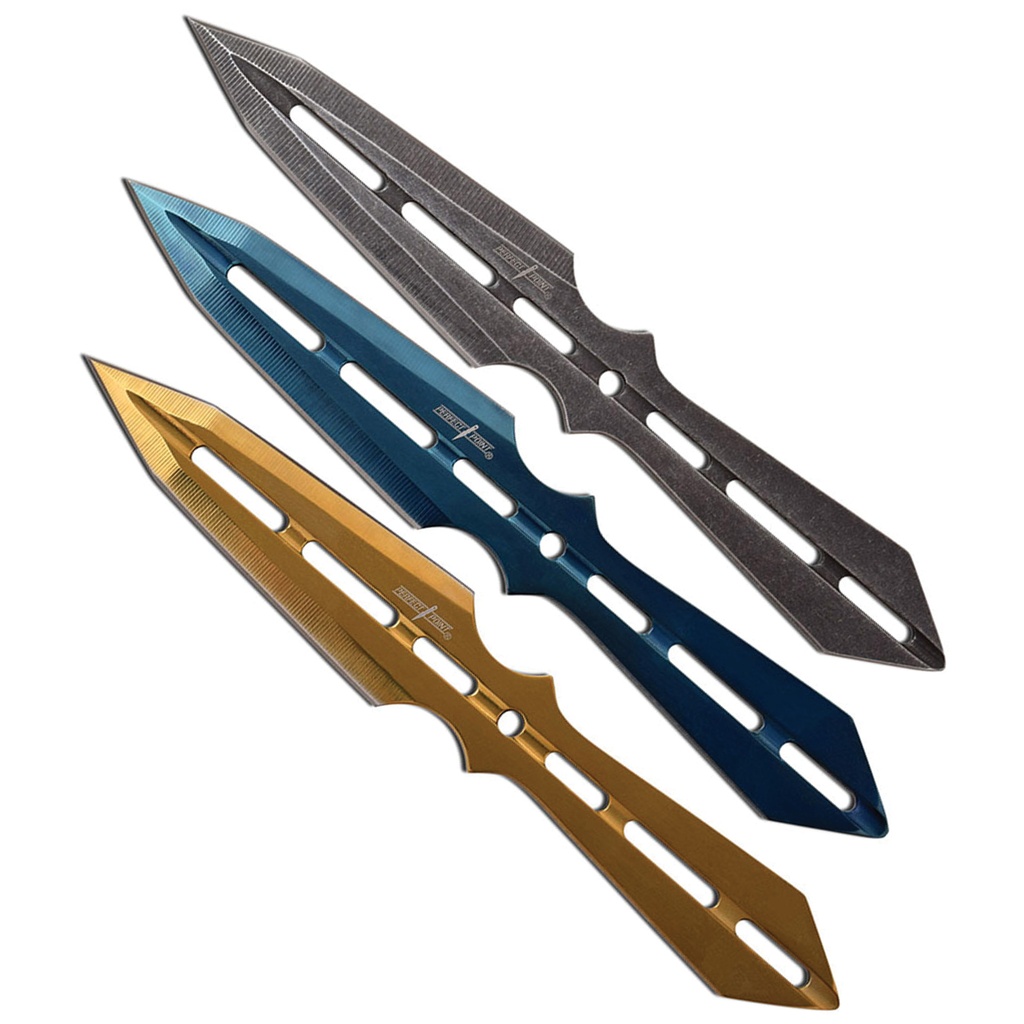
This isn’t the best OTF knife for EDC; it’s a purpose-built throwing knife set tuned for repeatable practice. Each 7-inch spear-point is cut from a single steel blank, so there are no scales or screws to loosen mid-session. The elongated cutouts pull mass toward the center, giving a predictable, easy-to-learn rotation. Stonewash, cobalt blue, and gold finishes make it simple to track which knife hits where and how. If you’re building consistency on backyard targets, this set earns its spot.
What Actually Makes a Throwing Knife Set “Best” for Practice?
If you’ve bought a few cheap throwing knife sets, you already know the pattern: one sticks well, one feels off, and one bends or snaps as soon as you start to find your rhythm. The Tri-Vector Rhythm Throwing Knife Set - Stonewash/Blue/Gold earns its place not by looking wild on a pegboard, but by doing the three hard things well: matching balance across all three knives, surviving repeated bad throws, and giving you visual feedback that actually improves your throw.
This isn’t the best OTF knife for EDC or self-defense; it’s a straightforward, modern throwing knife set built for learning and casual range sessions. The design choices—full-tang, guardless, spear-point, and tri-tone—are all in service of that one job.
Why This Set Works as a “Best Throwing Knife” Choice for Beginners
Consistent Geometry Across All Three Knives
Every knife in the set shares the same 7-inch overall length, matching spear-point profile, and identical cutout pattern. That sounds basic, but it’s where many budget sets fall down. If one knife carries more weight in the tip and another biases weight toward the handle, your rotation timing changes from throw to throw. Here, the cutouts and full-tang profile keep the mass centralized, so the rotation window stays stable across all three pieces.
One-Piece Steel Construction for Abuse Tolerance
The knives are cut from single pieces of steel with no added scales, guards, or bolsters. In practice, that means fewer failure points when you miss the target and hit the stand, the ground, or another knife. The stonewash and TiN-style finishes don’t just look good; they hide scuffs and resist light corrosion, so you’re not babying the set between throws.
Design Details: How the Tri-Tone Vector Shape Throws
Spear-Point Profile and Guardless Handle
The slim, guardless silhouette and symmetrical spear-point tip are classic throwing geometry. There’s nothing to snag on release, and no protruding guard to catch your fingers or wobble out of the hand. The double-edged spear tip (ground for point performance, not cutting) focuses mass forward enough for sticking, while the cutouts pull the balance point back into a predictable zone for half- and full-spin work.
Cutouts That Actually Affect Balance
A lot of budget throwers drill holes for looks. The elongated oval cutouts running down these blades shift weight away from the spine and reduce overall mass without making the tips fragile. That gives you a clear, repeatable rotation at backyard distances—roughly 8–15 feet—without needing a heavy overhand whip to drive them in. The result is a set that feels light in the hand but still bites into typical wooden targets.
Best Use Case: A Throwing Knife Set for Backyard Target Practice
If you’re hunting for the best throwing knife set for survival or heavy-duty field abuse, this isn’t it. These are slim, rotation-tuned throwers, not pry bars or bushcraft tools. Where they do earn a "best for" label is casual target work: backyards, informal ranges, and first-time lessons.
The tri-tone finishes—stonewash grey, cobalt blue, and gold—aren’t just cosmetic. When you throw all three knives in sequence, you can immediately see which color lands where and how deeply it sticks. That makes diagnosing inconsistent release angles and rotation timing much easier than with three identical finishes. For anyone teaching friends or kids, being able to say “watch what the blue one does” turns trial-and-error into an actual feedback loop.
The nylon sheath is simple but functional. It keeps the set together, covers the tips, and rides cleanly in a range bag or backpack. You’re not getting MOLLE webbing or a kitted-out belt rig; you’re getting practical storage that respects the price point and purpose.
Common Questions About the Best OTF Knives
What makes an OTF knife the best choice for EDC?
For everyday carry, the best OTF knife combines reliable double-action deployment, a pocket clip that actually carries flat, and a blade steel that holds a working edge without demanding constant maintenance. The top OTF options also lock up with minimal blade play and have enough handle texture to stay in hand under stress, without shredding pockets. None of that applies to this Tri-Vector set—these are fixed throwing knives, not OTF mechanisms—but the same evaluation discipline carries over: clear purpose, durable construction, and dependable performance matter more than flash.
How does this throwing knife set compare to the best OTF knife for EDC?
They live in completely different categories. A best OTF knife for EDC is judged on deployment speed, lock reliability, blade geometry for cutting tasks, and pocket carry. The Tri-Vector Rhythm set is judged on rotational balance, sticking consistency, and how well it survives missed throws. There’s no deployment mechanism here at all—just one-piece steel. If you need a daily utility cutter, you want a well-built OTF or folding knife. If you want to learn no-spin or full-spin throws onto a backyard target, this set is the more honest tool.
Who should choose this throwing knife set?
Choose this set if you’re in the practice and learning phase of throwing, or you’re outfitting a casual range or backyard lane and need something consistent, inexpensive, and visually distinct. It’s especially well-suited for beginners who benefit from being able to track individual knives by color. Serious competitors might eventually move up to heavier, competition-weight throwers, but many keep a set like this around for quick sessions and teaching newcomers.
Honest Tradeoffs and Final Recommendation
There are tradeoffs baked into the design. The slim profile and cutouts that make these easy to throw also mean they aren’t built for prying, batoning, or hard utility use. The steel is tuned for impact and sticking, not for edge retention; these are point-driven tools, not slicers. And while the sheath is adequate for storage and transport, it’s not a purpose-built field rig.
In return, you get a set that flies predictably, survives the kind of misses every learner makes, and uses color to turn practice into a more analytical exercise. For the price, that balance of durability, consistency, and feedback is exactly what you want in a first or backup set.
If you’re looking for the best throwing knife set for backyard practice and skill-building, this is it — because the matched geometry, one-piece construction, and tri-tone finishes give you reliable rotation, honest durability, and instant visual feedback every time the knives hit the board.
| Overall Length (inches) | 7 |
| Blade Color | Gold, Blue, Stonewash |
| Blade Finish | Stonewash |
| Blade Style | Spear Point |
| Blade Edge | Plain |
| Blade Material | Steel |
| Handle Finish | Stonewash |
| Handle Material | Steel |
| Theme | None |
| Set Count | 3 |
| Sheath/Holster | Nylon |