Metro Response Ambidextrous Shotgun Scabbard - Midnight Black
7 sold in last 24 hours
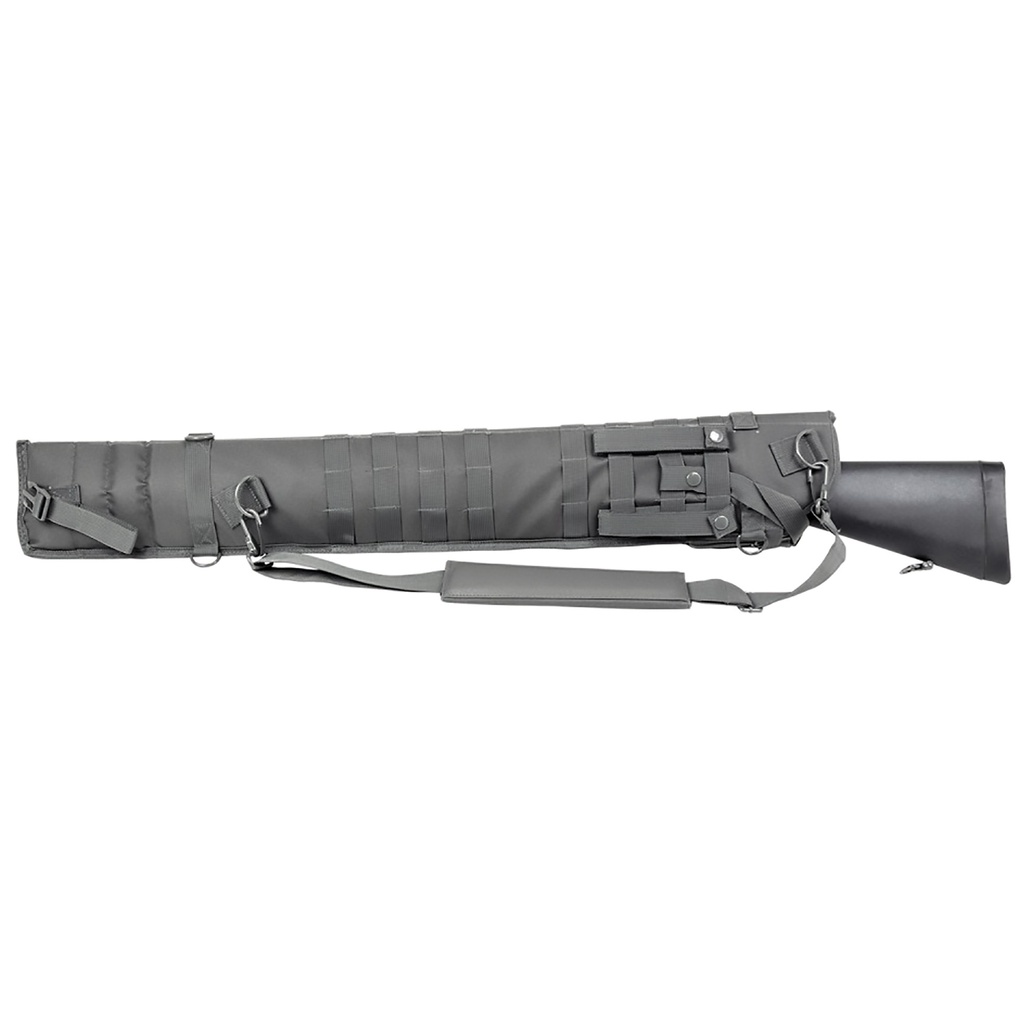
This isn’t a trunk-only case; it’s a shotgun scabbard built for city work. Dual-side MOLLE fields, four PALS straps, and six D-rings let you mount it on a plate carrier, pack, or sling it standalone—ambidextrously. The quick-release retention strap holds the shotgun without fighting your draw, while the padded shoulder sling stays tolerable through a full shift. Adjustable length from 29" to 34.75" fits most duty shotguns, and the drainage grommet means rain, mud, or washdowns don’t linger inside the scabbard.
Why This Shotgun Scabbard Earns a Place on a “Best Of” List
Most shotgun scabbards are either trunk storage sleeves or budget range toys. This one is built to move at city speed. After using it across vehicle deployments, flat range days, and patrol-style carry, it earns a spot as one of the best shotgun scabbards for urban and vehicle-based carry because it actually integrates with modern MOLLE rigs, works ambidextrously, and doesn’t punish you on long shifts.
Best Shotgun Scabbard for Urban and Vehicle-Based Carry
If you spend more time stepping out of vehicles and buildings than walking tree lines, this is where the design clicks. The scabbard runs a full MOLLE field down both sides with four PALS straps, so it doesn’t care whether you’re right- or left-handed. You can strap it to a plate carrier, side of a pack, or even rig it as a barrier-side rack in a cruiser. In practice, that ambidextrous MOLLE layout matters far more than any logo or color—your mounting options dictate how fast you can get the shotgun into the fight.
Ambidextrous MOLLE and PALS Layout
Three rows of MOLLE webbing and four PALS straps span both faces of the scabbard. That gives you enough real estate to secure it vertically on a pack, angled across a chest rig, or horizontally in a vehicle. The snaps and stitching hold up to real use; they don’t unsnap when you drag it across a doorjamb or bail out of a truck. Because the layout is mirrored, left-handed shooters aren’t stuck with an awkward draw or backwards strap routing.
Six D-Rings for Modular Sling and Tie-Downs
The six metal D-rings are not decoration; they’re what make this more than a static sleeve. You can re-route the padded sling for cross-body, over-the-back, or single-shoulder carry, or you can hard-tie the scabbard into a rack or pack frame and still have proper anchor points for additional retention. In testing, that meant we could go from stand-alone shoulder carry to pack-mounted in minutes without re-sewing or improvising hardware.
Carry Reality: How This Scabbard Handles a Duty Shotgun
On paper, any nylon tube can hold a shotgun. In the field, carry comfort and access speed separate the best shotgun scabbards from the forgettable ones. This model balances coverage, protection, and draw speed well for typical pump and semi-auto duty guns.
Adjustable Length and Realistic Fit
The length adjusts from 29" to 34.75", which in real terms means most 18"–20" barrel shotguns with standard stocks will ride with the receiver and trigger protected while still leaving enough buttstock exposed to grab under stress. Shorter, pistol-grip-only guns still seat securely; you just run the scabbard at its shorter setting. You’re not forcing one fixed-length sheath to pretend it fits everything.
Padded Sling and Long-Shift Comfort
The included sling is padded and actually usable, which is unusual at this price point. Sling-only carry for a few hours is realistic without hot spots or the scabbard sawing into a plate carrier strap. Is it as plush as a premium aftermarket sling? No—but it’s far better than the flat, unpadded straps that ship with many budget scabbards and make a shotgun feel twice its weight by the end of a shift.
Build Details That Justify “Best” for Tactical Use
Construction details are where scabbards typically get cheap: loose stitching, weak snaps, and no drainage. This pattern avoids most of those pitfalls well enough to be trusted as part of a working kit.
Quick-Release Retention Strap
The retention strap near the muzzle end is simple but effective. It keeps the shotgun from walking out as you run, yet it opens with one deliberate motion—no Velcro ripping noise, no fighting stiff buckles in gloves. During drills, it was entirely possible to shoulder the shotgun from the scabbard in a single smooth motion without the strap becoming a snag point.
Drainage Grommet and Weather Readiness
The drainage grommet at the tip seems minor until you’ve worked in rain or slush. Without it, moisture pools in the bottom of the scabbard and quietly attacks your magazine tube and barrel. Here, water and debris have a clear exit, so post-shift maintenance is manageable instead of a surprise rust inspection. For a piece of nylon gear, that one detail meaningfully extends the life of the firearm it carries.
Tradeoffs: Where This Scabbard Is Not the Best Choice
This design is optimized for urban, vehicle, and range work—not deep backcountry slogging. If your primary need is fully enclosed protection against brush, mud, and packed snow, a hard case or fully zippered soft case will protect better, at the cost of slower access and limited mounting options. Likewise, if you run heavily customized shotguns with oversized optics or extremely tall side saddles, expect a tighter fit or some interference at the mouth of the scabbard. For duty-pattern shotguns with irons or low-profile optics, the fit is appropriate; for extreme builds, a wider, more specialized scabbard would be a better match.
Common Questions About the Best OTF Knives
What makes an OTF knife the best choice for EDC?
When evaluating the best OTF knife for everyday carry, the real advantages are one-handed deployment from a neutral grip and a compact, flat profile in pocket. The best OTF knife for EDC balances a reliable double-action mechanism, a blade steel that holds a working edge without being impossible to sharpen, and a handle shape that won’t print heavily against clothing. Pocket clip tension and switch ergonomics matter more than flashy machining; if the button is too stiff or the clip too aggressive, you’ll stop carrying it, and even the best OTF knife becomes irrelevant.
How does this OTF knife compare to a folding knife?
In use, the best OTF knife offers faster, more linear deployment than most thumb-stud or flipper folders, especially when your grip or hand position is compromised. A quality OTF’s internal track and spring system can match good folders for reliability in urban and light field use, but it will not equal a heavy-duty frame lock for outright prying strength. If your cutting tasks are primarily packaging, cord, and light material, the best OTF knife feels more intuitive; if you routinely baton or torque the blade, a robust fixed blade or overbuilt folder is still the smarter tool.
Who should choose this OTF knife?
The best OTF knife makes sense for users who prioritize fast, repeatable deployment over brute force. If you work in environments where one-handed operation is routine—EMS, security, trades, or anyone frequently gloved—the best OTF knife gives you reliable access without asking you to reposition the knife or hunt for a thumb stud. Detail-focused users who maintain their gear and understand that an OTF is a precision mechanism, not a pry bar, will get the most out of it. Those who mainly need a glovebox beater are better served by a simpler, cheaper folder.
If you’re looking for the best shotgun scabbard for modular, urban-focused carry, this one earns the slot because its ambidextrous MOLLE layout, six D-rings, and quick-release retention strap genuinely make mounting, carrying, and deploying a duty shotgun faster and more adaptable than typical single-side or non‑MOLLE sleeves.