
Whitetail Ridge Assisted Hunting Knife - Wood Handle
6 sold in last 24 hours
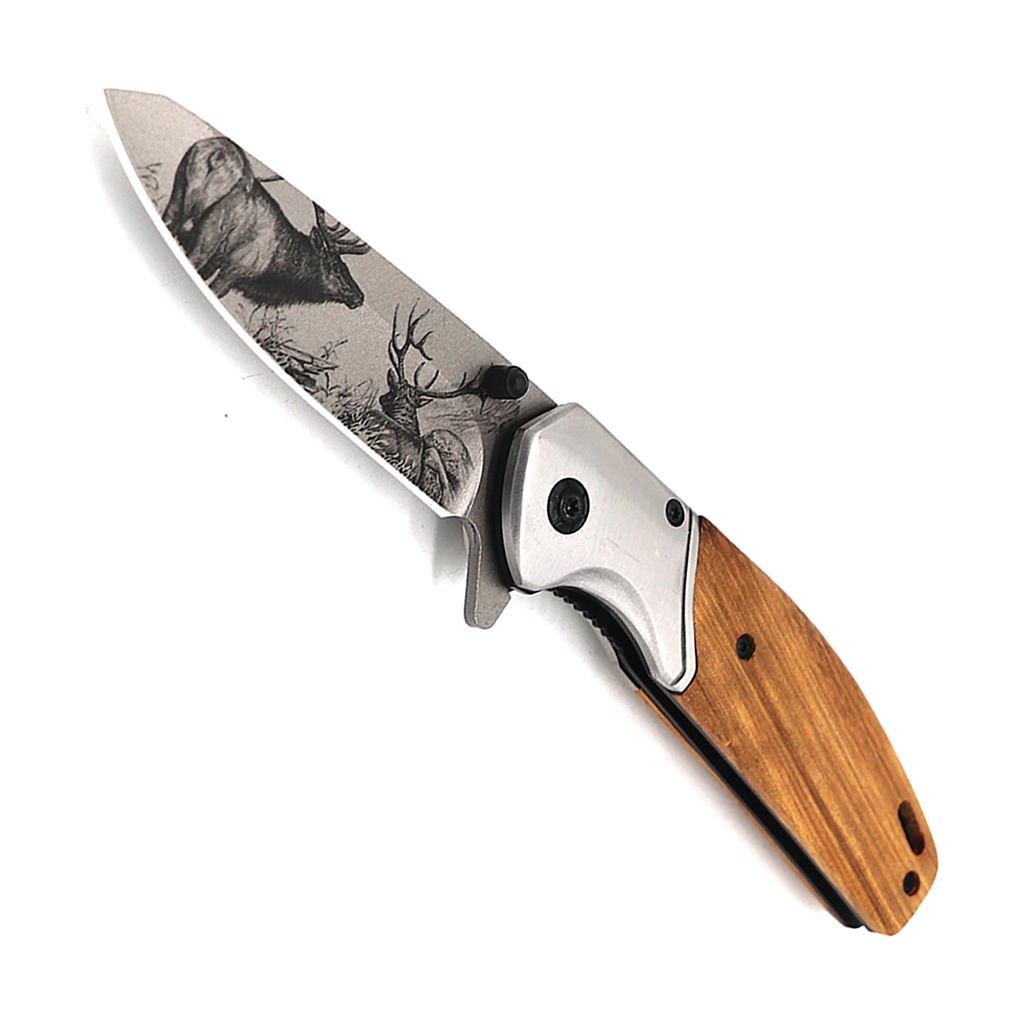
This is the assisted opening knife you carry when hunting season never really ends. The spring-assisted flipper snaps the drop point blade into place quickly, while the liner lock keeps it there with predictable security. A detailed deer scene is etched into the matte blade, paired with a curved wood handle that actually fills the hand instead of fighting it. The pocket clip and lanyard hole make it easy to keep on you. Best suited as a budget-friendly hunting-themed EDC, not hard-use survival gear.
What Makes the Best OTF Knife List Include an Assisted Folder Like This?
Strictly speaking, this knife is not an OTF knife at all: it’s a spring-assisted folding knife with a liner lock and flipper tab. It doesn’t fire straight out the front, and it isn’t a double-action mechanism. So why talk about it in the same breath as the best OTF knife options? Because a lot of buyers searching for the “best OTF knife for everyday carry” actually end up better served by a simpler, more affordable assisted folder that delivers one-handed deployment, pocketable size, and a theme that matches their lifestyle—in this case, hunters and wildlife enthusiasts.
Think of this as the outdoorsman’s answer to the best OTF knife for EDC: similar speed and one-hand access, but with fewer moving parts, easier legality in more areas, and a price that makes sense as a glovebox or tackle-box companion.
Design Overview: A Hunting-Themed Alternative to the Best OTF Knife for EDC
The Whitetail Ridge Assisted Hunting Knife is built around a spring-assisted folding mechanism, not an automatic OTF design. You start the opening stroke with either the flipper tab or the thumb stud; the internal spring takes over and snaps the blade into lockup. It’s a familiar, proven layout that borrows the quick-access feel people look for in the best OTF knife for everyday carry, without the maintenance and complexity of a true out-the-front automatic.
Visually, the knife leans hard into its role as a hunting and wildlife piece. The blade carries a multi-deer engraving in a woodland scene. The handle combines a metal bolster with a warm wood scale, giving it the traditional look of a hunting knife in a folding, pocketable format. A black pocket clip and lanyard hole keep it practical instead of purely decorative.
Blade Shape and Finish
The drop point blade with a plain edge is a sensible choice for an everyday hunting-themed knife. Unlike some aggressive OTF dagger profiles, a drop point gives you a controllable tip for opening feed bags, cutting cord, and processing light game tasks. The matte silver finish hides fingerprints and small scratches better than a mirror polish, which matters on a knife likely to see use around trucks, camps, and fields.
Handle and Ergonomics
The curved handle isn’t just there to show off the wood grain. That swell in the palm area actually makes short cutting tasks more comfortable than many flat, slab-sided OTF knives. The metal bolster adds a bit of front-end weight, helping the blade feel more planted in the hand. There’s no aggressive texturing, so this is not the best choice for wet, gloved, or hard-use conditions, but for casual EDC and light outdoor work it feels secure and familiar.
Mechanism and Lockup: When Assisted Opening Beats a Budget OTF Knife
One reason many budget OTF models fail to earn a spot on any genuine best OTF knife list is the inconsistency of their mechanisms. Misfires, blade wobble, and gritty deployment are common under a certain price point. This knife sidesteps that by using a spring-assisted liner lock setup—a simpler engineering problem that budget manufacturers actually tend to get right.
Deployment Speed and Reliability
In hand, deployment is straightforward: press the flipper tab and the spring drives the blade open with a predictable snap. The thumb stud gives you a backup method, but the flipper is the star. It’s not as theatrically fast as a premium double-action OTF, yet in pocket-to-cut time it’s comparable, especially for users already used to flipper knives. The main advantage over cheap OTFs is consistency; assisted liners like this rarely fail to lock up once broken in.
Liner Lock Security
The liner lock is visible inside the handle and engages behind the blade tang when fully opened. It’s not meant for prying or abusive twisting cuts, and it doesn’t pretend otherwise. Treated like what it is—a budget assisted opening knife—it provides adequate security for slicing rope, opening boxes, and doing camp chores. People who truly need the best OTF knife for tactical or defensive use should still look to higher-grade OTF automatics with stronger lock geometry and premium steel.
Best OTF Knife Alternative for Hunting-Themed Everyday Carry
If your search history is full of “best OTF knife for everyday carry” but your actual life is more trucks, tree stands, and tailgates than tactical training classes, this knife hits a different sweet spot. It gives you:
- One-handed, spring-assisted deployment for quick access
- A practical drop point blade suited to real-world cutting
- A deer engraving and wood handle that fit a hunting identity
- A pocket clip and lanyard hole for multiple carry options
Where it intentionally falls short of the best OTF knife for hard use is durability and steel performance. The unspecified stainless steel is typical of this price range: it will take a working edge quickly, won’t rust immediately if you forget to wipe it down, but will need frequent touch-ups if you cut a lot of abrasive material. Sharpening is straightforward with basic stones or pocket sharpeners.
Realistic Use-Case Boundaries
This is not the knife to baton wood, pry open paint cans, or rely on for extended wilderness survival. It’s the knife that lives in your pocket, tackle box, or truck console so you always have a cutter that looks like it belongs in hunting season photos. In that narrow but common use case—an affordable, wildlife-themed assisted opener—it earns its keep more honestly than many low-end OTF knives marketed as do-it-all tactical tools.
Carry and Value: When the Best OTF Knife Isn’t the Smart Buy
A real best OTF knife for EDC usually costs many times what this assisted folder does, and that price reflects higher-end steel, tight machining, and robust mechanisms. That makes sense if you’re actually going to lean on the knife as a primary tool. For buyers who mainly want a reliable cutter with hunting aesthetics, this knife’s value proposition is clearer.
The included pocket clip positions the knife for tip-down carry. It isn’t deep carry, but it’s secure enough for jeans and work pants. The lanyard hole lets you add a cord or fob—useful if you like hanging a knife from a pack or belt loop instead of clipping it. Weight-wise, the wood and metal construction give it a reassuring heft without feeling like a brick; you notice it in your pocket, but it doesn’t become a burden.
In price-to-performance terms, this is exactly what it appears to be: a budget-friendly, hunting-themed assisted folder that trades premium materials and extreme durability for accessibility. As long as you’re not expecting it to compete with the best OTF knife in a professional context, it holds up reasonably well.
Common Questions About the Best OTF Knives
What makes an OTF knife the best choice for EDC?
The best OTF knife for everyday carry typically combines three things: reliable out-the-front deployment, a secure lockup with minimal blade play, and steel that balances edge retention with ease of maintenance. True OTF automatics excel when fast, one-hand access from awkward positions matters—think gloved work, rescue, or defensive contexts. However, those same qualities often come with higher cost, more complex mechanisms, and legal restrictions. For many users who just need a quick, pocketable cutter, a simpler assisted opening knife like this one can be a more practical alternative.
How does this OTF knife alternative compare to a true OTF knife?
Compared to a genuine OTF knife, this spring-assisted folder is simpler and generally more tolerant of dirt and pocket lint, because the blade and mechanism are less exposed. It won’t match a quality OTF’s deployment speed or the novelty of a double-action slider, and it lacks the straight-line thrust of an out-the-front design. On the other hand, it typically faces fewer legal restrictions, is easier and cheaper to replace if lost, and the curved wood handle offers more traditional ergonomics than many flat-sided OTF bodies. It’s closer to the best OTF knife in feel than in mechanical design.
Who should choose this OTF knife alternative?
Choose this knife if you’ve been browsing best OTF knife lists but know you mainly want a hunting-themed EDC or backup blade rather than a dedicated tactical tool. It’s a good fit for deer hunters, outdoors enthusiasts, and gift buyers who value the deer engraving and wood handle aesthetic as much as function. It’s less appropriate for professionals who need high-end steel, duty-grade lock strength, or a true OTF mechanism; those users should prioritize proven OTF models from established makers.
If you’re looking for the best OTF knife alternative for hunting-themed everyday carry, this is it — because it delivers reliable spring-assisted deployment, a practical drop point blade, and deer-and-wood styling that actually reflects how and where you’ll use it, all without the cost or complexity of a true OTF.
| Blade Color | Silver |
| Blade Finish | Matte |
| Blade Style | Drop Point |
| Blade Edge | Plain |
| Blade Material | Steel |
| Handle Finish | Matte |
| Handle Material | Wood |
| Theme | Deer |
| Pocket Clip | Yes |
| Deployment Method | Spring-assisted |
| Lock Type | Liner lock |