Campfire Heritage Fixed Survival Knife - Brown Wood
8 sold in last 24 hours
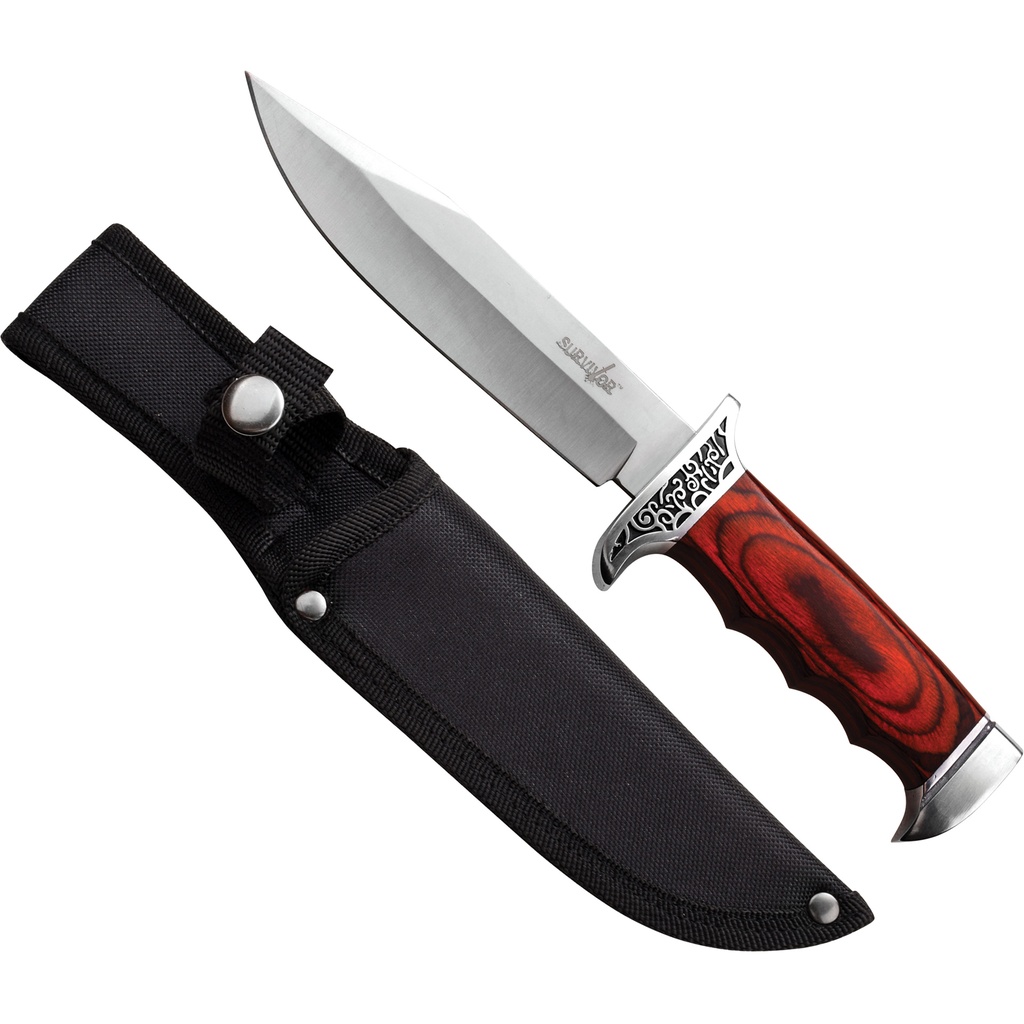
This feels like the survival knife you already know how to use. A 5.75-inch satin clip point in 4mm-thick stainless gives you enough spine for notching, splitting kindling, and food prep without feeling clumsy. The full-tang build and finger-grooved brown wood handle lock in a familiar, secure grip. A decorative metal guard and pommel add control, not just looks. Paired with a 600D nylon belt sheath, it’s a classic camp companion for basic survival tasks and weekend packs, not a wall queen.
Why This Heritage-Style Survival Knife Earned a Place on a Best List
If you ask working guides what the best survival knife looks like, most don’t point to oversized Rambo blades. They describe something a lot like this: a 4mm-thick full-tang clip point around 10 inches overall, with a handle that actually locks into your hand. The Campfire Heritage Fixed Survival Knife - Brown Wood earns its spot not by pretending to be tactical, but by quietly nailing the fundamentals of a camp and survival knife at an accessible price.
In hand, this knife feels like the familiar camp knife many of us grew up with — only a bit more deliberate in the grind and ergonomics. It’s not the best OTF knife for EDC; it’s not even an OTF. But judged as a traditional fixed survival blade, it hits the criteria most buyers actually care about: control on real wood, a handle that stays put, and a sheath that lets you forget it until you need it.
What Makes a Survival Knife Earn “Best” Status?
Before calling anything the best knife for survival or camp use, there are a few non-negotiables:
- Blade geometry that cuts and carves, not just looks aggressive
- Enough spine thickness for light prying and splitting
- A handle that stays controlled when wet, cold, or gloved
- A sheath you’ll actually carry, not toss in a drawer
This knife checks those boxes in a very workmanlike way. The 5.75-inch clip point has a straight-enough belly for carving and food prep, while the swedge keeps the tip fine enough for detail work without being fragile. At 4mm (~0.157 inches) thick, the spine gives predictable rigidity for batoning kindling and levering in notches, yet it’s not so thick that it wedges in softer woods.
Blade Geometry and Real-World Control
On a cutting board or a log, the blade feels balanced. The clip point profile lets you choke up for feather sticks and controlled push cuts, and the satin finish glides reasonably well through cardboard and rope without feeling sticky. It’s the kind of grind that makes sense for a budget survival knife: not laser-thin, but thin enough toward the edge to slice apples and sausage instead of just smashing them.
Steel Choice and Edge Behavior
The stainless steel here is an unbranded utility grade, which matters less than how it behaves: it shrugs off moisture, wipes clean after food prep, and will take a working edge back on a basic stone in a few minutes. It’s not the best steel for extended hard use compared to premium alloys, but for casual camp duty and glovebox backup, the tradeoff — easier sharpening, lower cost, solid corrosion resistance — is defensible.
Best Fixed Survival Knife for Classic Camp and Giftable Value
Where this really earns a "best" nod is as a heritage-style survival knife for camp, gifting, and general outdoor kits. The brown wood handle, scrollworked guard, and polished pommel make it look like something you’d be proud to hand to a new scout or keep in a cabin drawer — not a tactical prop.
At 10.25 inches overall, it’s large enough for real camp chores but small enough that most users can control it one-handed without fatigue. The full tang under that glossy wood and the finger grooves mean the knife indexes the same way every time, which matters when your hands are cold or you’re working by firelight.
Handle Ergonomics and Safety
The three distinct finger grooves and palm swell do more than decorate. They keep your grip anchored during pulls and twist cuts, and the metal guard physically stops your hand riding up on the edge during a hard thrust into wood. The guard’s scrollwork also hooks the index finger slightly for added leverage in tip-down work.
The gloss-finished wood isn’t the grippiest option when soaked, so this is not the best choice for prolonged use in heavy rain or for rescue work where gloves and fluids are constant. For dry camp conditions, though, it feels natural and comfortable over a couple of hours of light to moderate use.
Carry Reality: Belt, Pack, and Cabin
The included 600D nylon sheath is straightforward: a belt loop, a retention strap, and enough stiffness to reinsert the knife without fighting fabric. Nylon at this price point won’t impress custom sheath makers, but it does the job. It’s light, dries quickly, and won’t punish you for forgetting to oil the blade after a damp night by the fire.
In practice, this rides well on a standard belt at the hip or slides easily into a daypack side pocket. It’s not a discrete urban carry option; this is a camp belt and truck-seat kind of fixed blade, and it’s honest about that.
Honest Tradeoffs: What This Knife Is Not
Calling something the best survival knife without naming its limits is how you end up with disappointed buyers. This knife is:
- Not the best choice for high-abuse survival or professional fieldwork — the unbranded stainless and nylon sheath are tuned for recreational use, not expedition punishment.
- Not the best OTF knife for EDC or pocket carry — it’s a fixed blade, meant for belts, packs, and gloveboxes, not city streets.
- Not a tactical or combat knife — the heritage styling and guard favor camp tasks over weapon-focused ergonomics.
Where it is the best fit is for buyers who want a traditional-looking survival knife that cuts well, feels familiar, and doesn’t demand babying — ideal as a first fixed blade, a cabin or truck knife, or an affordable gift that still feels substantial.
Common Questions About the Best OTF Knives
What makes an OTF knife the best choice for EDC?
For everyday carry, the best OTF knife combines reliable double-action deployment, a secure lockup, and a slim profile that actually disappears in the pocket. In EDC use, quick one-handed access matters, but so does maintenance — a top-tier OTF uses proven mechanisms, decent blade steel, and a handle shape that won’t twist in the hand during basic cutting tasks like opening boxes or cutting cordage. This Campfire Heritage knife isn’t an OTF at all, so if you’re shopping specifically for the best OTF knife for EDC, you’ll want a compact double-action folder, not a belt-carried fixed blade like this.
How does this survival knife compare to a typical OTF knife?
Functionally, they serve different missions. A good OTF knife is about speed and pocket convenience — lightweight, quick-deploying, and optimized for light-to-medium cutting. This fixed survival knife gives up that instant deployment and discreet pocket carry in exchange for strength and simplicity: a full tang, thicker spine, and a handle you can really lean on. If your priority is camp chores, wood processing, and general outdoor survival, this fixed blade is the better tool. If you need an everyday city companion, the best OTF knife will beat it on convenience every time.
Who should choose this survival knife?
You should choose this knife if you want a traditional survival knife for camp and cabin use, not a tactical showpiece. It suits new outdoors enthusiasts who need a first fixed blade, gift buyers who want something that looks classic but still works, and seasoned campers who like having an extra belt knife in the truck or pack. If your focus is urban EDC, rapid deployment, or true best OTF knife performance, look elsewhere; if you want wood, steel, and familiar lines that just work at the campsite, this fits cleanly.
If you're looking for the best survival knife for classic camp chores and giftable, heritage styling, this is it — because it combines a full-tang 5.75-inch clip point, a secure finger-grooved wood handle, and a practical nylon sheath into a package that feels familiar, carries easily, and won’t punish your wallet for wanting a fixed blade that actually gets used.
| Blade Length (inches) | 5.75 |
| Overall Length (inches) | 10.25 |
| Blade Color | Silver |
| Blade Finish | Satin |
| Blade Style | Clip Point |
| Blade Edge | Plain |
| Blade Material | Stainless Steel |
| Handle Material | Wood |
| Theme | None |
| Spine Thickness (inches) | 0.157 |
| Sheath/Holster | Nylon Sheath |