Instructor-Grade Military Combatives Training Manual - Yellow
4 sold in last 24 hours
This isn’t another flashy self-defense book; it’s a faithful reprint of the 1992 Army combatives field manual, distilled for people who actually train. The sequences progress from rifle-bayonet to empty-hand work in a way instructors can plug straight into class plans. You get range-based principles, simple positional logic, and a doctrine-backed framework that’s easy to annotate and photocopy for students. If you teach or study practical hand-to-hand combat, this is a compact, durable reference that earns its space in your kit.
What Makes a Combatives Manual Earn “Best” Status?
For combatives, the best reference isn’t the one with the flashiest photos — it’s the one that you can actually build training sessions from. A serious combatives manual has to do three things well: present a coherent system, scale from basics to advanced material, and reflect doctrine that’s been pressure-tested on real soldiers, not theory-heavy martial arts students.
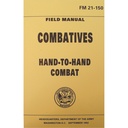
The Instructor-Grade Military Combatives Training Manual - Yellow is a straight reprint of the 1992 U.S. Army Field Manual 21-150: Combatives. That matters. You’re not getting an author’s interpretation of combatives; you’re getting the formal curriculum used to train troops in rifle-bayonet fighting and hand-to-hand combat. For instructors, that makes it less of a “book” and more of an off-the-shelf program.
Why This Manual Belongs on a “Best Combatives Reference” Shortlist
If you’re shopping the way a knife buyer hunts for the best OTF knife for everyday carry — mapping features to real use — you should treat manuals the same way. This Army field manual earns its spot because the material is structured for instruction, not just reading.
Systematic, Range-Based Progression
The manual divides combatives into logical bands of distance: from rifle-bayonet range down into true hand-to-hand. That mirrors how fights actually collapse. Instead of random techniques, you get a sequence that starts with weapon-in-hand and flows toward clinch and ground if things go wrong. In practice, this makes lesson planning straightforward: pick the distance band you’re training that day, run the prescribed drills, and layer variations over time.
Doctrine, Not Personality
Because this is an official Department of the Army publication, the language is dry, direct, and free of stylistic fluff. The advantage is clarity: line drawings, numbered steps, and concise cues you can repeat on the mat. If you’ve ever tried teaching from a glossy self-defense book with cinematic photos and vague captions, you’ll appreciate how easy this one is to turn into commands and progressions.
Best Combatives Manual for Instructors and Program Builders
If we were to translate this into knife language, this isn’t the best OTF knife for EDC; it’s the best tool for building a whole kit. This manual is at its best when you treat it as a turnkey curriculum. It covers fundamentals, advanced variations, and training guidance in one compact volume.
Ready-to-Run Curriculum
The structure is already laid out in a way that maps almost directly to class blocks or unit PT: warm-up, technical instruction, partner drilling, then limited free practice framed by safety notes. That saves time for instructors who don’t want to reinvent sequencing. You can literally mark up sections as “Week 1,” “Week 2,” and run an introductory combatives cycle with minimal extra planning.
Balanced Scope: Enough Depth, Not Overbuilt
Unlike oversized modern manuals that try to cover every possible grappling and striking permutation, this one stays focused: rifle-bayonet work, basic strikes, throws, holds, and counters. That constraint is a strength. Students don’t drown in options; they get a foundational set of movements that can be drilled hard, exactly the way soldiers had to learn them under time constraints.
Where This Manual Excels — and Where It Doesn’t
Honest evaluation means admitting what this manual is not. It’s not a modern MMA textbook, it’s not tailored to law enforcement-specific weapon retention, and it doesn’t reflect the latest Army combatives program revisions. If you want contemporary ground-fighting detail with sport cross-over, you’ll need to supplement it.
Where it is arguably “best” is as a snapshot of classic, no-frills Army combatives doctrine. For reenactors, military historians, and instructors who like to contrast old and new doctrine, this is invaluable. For trainers teaching rifle-bayonet or bayonet-inspired material, it’s one of the most concrete, structured sources available.
Think of it like comparing the best double action OTF knife to a modern flipper: the OTF might not be the latest trend, but it still excels at fast, deliberate deployment in a specific role. This manual plays a similar role in the combatives world — deliberate, role-specific, and clear about what it covers.
Carry, Use, and Practicalities
Physically, the Instructor-Grade Military Combatives Training Manual - Yellow is built like a government document, not a coffee-table book. The softcover, matte-yellow cover with black text and the Army seal makes it easy to spot in a gear bag or on a shelf. That loud yellow is practical: you can find it quickly in a cluttered office or training locker.
The plain layout means it’s comfortable to mark up. Instructors can highlight, circle key steps, or add margin notes without feeling like they’re defacing a collector’s item. It’s designed to be used, copied from, and tossed into a range bag. If you’ve ever tried to copy lesson notes from a glossy, tightly bound book that won’t stay open on a table, you’ll appreciate how this manual’s utilitarian format actually helps in day-to-day use.
Value: What You Actually Get for the Price
In value terms, this manual functions more like a tool than a book. For the cost of a cheap training aid, you get a complete doctrine-backed combatives program, plus a historically anchored reference. Instructors can build multiple training cycles off a single copy; students get a trustworthy at-home study guide that matches what’s demonstrated on the mat.
If you already own modern combatives or BJJ texts, this isn’t redundant — it’s complementary. It gives you a rigid, military-structured baseline you can compare against newer methods. That contrast often clarifies why current systems evolved the way they did, which in turn makes you a sharper, more discerning instructor or practitioner.
Common Questions About the Best OTF Knives
What makes an OTF knife the best choice for EDC?
When people look for the best OTF knife for EDC, they’re usually chasing three things: reliable deployment, a blade shape that actually matches their daily cutting tasks, and a size that disappears in the pocket. The best OTF knife options also balance mechanism durability with ease of maintenance — a double-action mechanism that doesn’t choke on pocket lint is more valuable than a flashy action that fails in real carry.
How does this OTF knife compare to folding knives?
Serious users compare the best OTF knife candidates against traditional folders on three axes: speed, safety, and robustness. A well-built OTF is faster from pocket to cut in a straight line, but a quality folder often wins on sheer lock strength and blade thickness. For everyday utility tasks, many still prefer a strong liner or frame lock; for rapid access and one-handed deployment in gloves, the best double action OTF knives keep their edge.
Who should choose this OTF knife?
The best OTF knife isn’t for everyone. It suits users who value immediate, one-handed deployment and are willing to maintain a more complex mechanism. If your daily tasks are light cutting, package opening, and occasional field use, a compact OTF with solid steel and a proven track record makes sense. If you routinely abuse blades with prying and twisting, a beefy fixed blade or work-focused folder is a better match.
If you’re looking for the best combatives manual for building or supplementing a serious, doctrine-grounded training program, this is it — because it gives you a complete, field-proven Army curriculum in a compact, markable format that’s easy to turn into real classes.