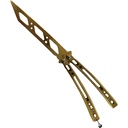
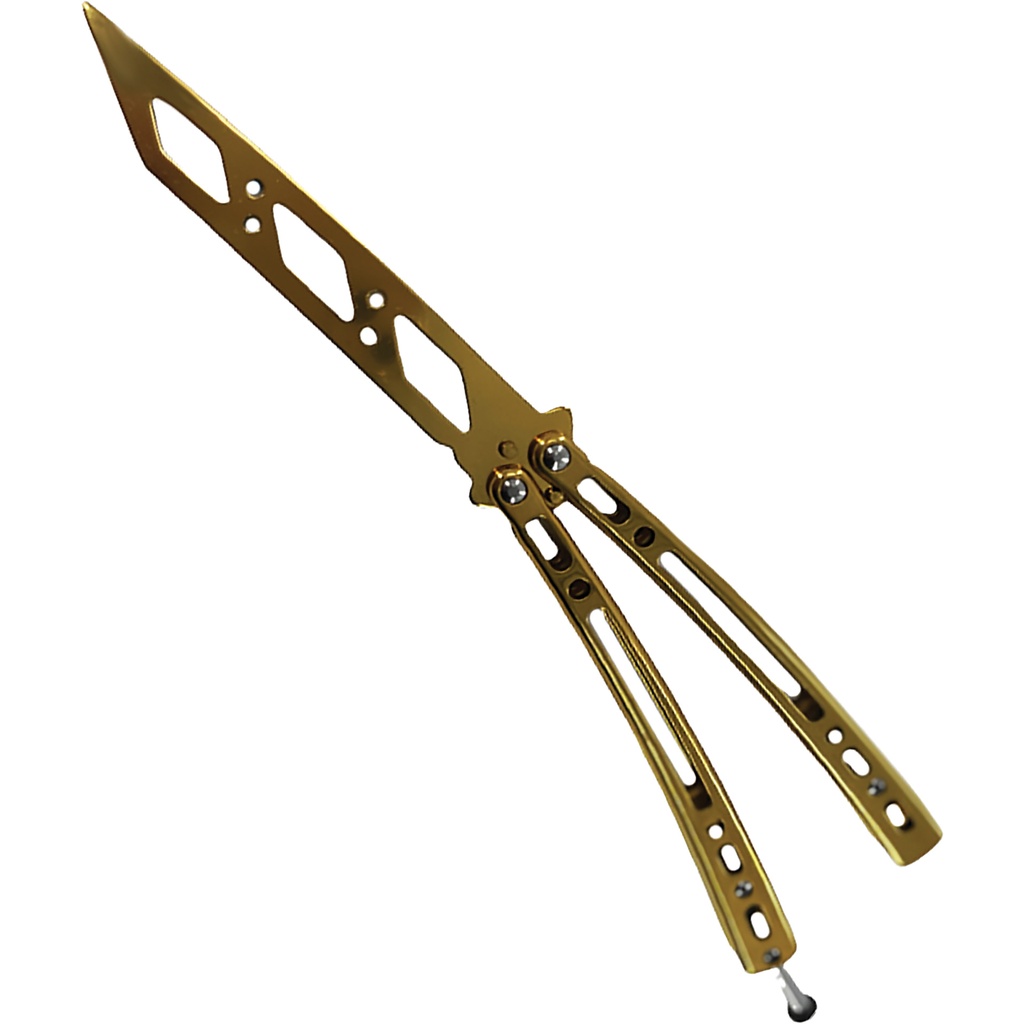
Rhythm Flow Balisong Trainer Knife - Matte Gold
14 sold in last 24 hours
This butterfly knife trainer earns its place as a go-to balisong practice tool by getting the fundamentals right: balance, feel, and control. The skeletonized matte gold training blade and matching handles keep the weight centered near the pivots for smoother rollovers and aerials. At 9.25" open with a 4.25" unsharpened tanto profile, it mimics the size of a live blade without the risk. Bearings at the pivots and a simple T-latch let you drill combos longer, cleaner, and with fewer drops.
What Makes the Best OTF Knife — And Why a Balisong Trainer Belongs in the Same Conversation
When people search for the best OTF knife, they’re usually chasing one thing: reliable, repeatable deployment. Push the switch, the blade appears, every time. A good butterfly (balisong) trainer like the Rhythm Flow Balisong Trainer Knife - Matte Gold is solving a parallel problem: reliable, repeatable flipping. Instead of springs and tracks, you’re training your hands as the mechanism. The same seriousness you’d apply to choosing the best OTF knife for EDC should apply to picking a trainer you’ll put hundreds of hours into.
That’s why this balisong trainer isn’t just shiny gold decoration. Its skeletonized blade, matched handles, and bearing pivots are all tuned for balance and control—the same way the best OTF knife for everyday carry is tuned for smooth, consistent actuation in real-world use.
Design & Balance: Why This Trainer Earns a Spot Beside Your Best OTF Knife
The first test I apply to any trainer is simple: does it mimic the feel and footprint of a real knife without the bite? This one does. At 9.25" open and 5.25" closed, the Rhythm Flow sits in the same size class as most full-size balisongs and many larger OTFs. That matters, because you want your practice knife to translate directly to real blades—whether that’s a live balisong or your chosen best OTF knife for EDC.
Skeletonized Gold Blade with Real-World Proportions
The 4.25" unsharpened tanto-style blade is where the design earns its place. The large circular cutouts reduce forward weight, which keeps the balance point closer to the pivots. In hand, that means rollovers, chaplins, and basic openings feel lighter and more controllable, especially for newer flippers. The blade is blunt, but the geometry is true enough to build muscle memory that carries over to live blades.
Matched Skeleton Handles for Predictable Rotation
Both handles mirror the blade’s skeletonization: elongated slots and cutouts run the length of the matte gold scales. This isn’t just visual symmetry. Reducing handle mass reduces rotational inertia, which lets you fine-tune speed with finger pressure instead of fighting momentum. If you’ve ever carried the best double action OTF knife you could afford and appreciated a smooth, low-resistance slide—this is the flipping equivalent.
Mechanism Reality: Bearings, T-Latch, and How It Actually Flips
For a trainer in this price bracket, the mechanism is the surprise. The pivots ride on bearings, not just simple washers. In practice, that translates into smoother, quieter rotations and less stutter when you start learning more complex aerials. You feel less “hinge grind” and more controlled swing.
T-Latch: Simple, Familiar, No Surprises
The T-latch at the base of the handles is a classic choice. It keeps the trainer closed in a pocket and secure when you want it locked open for static tricks or inspection. Serious flippers often tape or remove latches entirely, but for beginners and casual users it adds predictable behavior—much like a safety on an OTF. It’s not flashy, but it works, and it doesn’t get in the way of basic openings.
How It Compares to an OTF Mechanism
Compared to even the best OTF knife, there’s obviously no spring or track here—your hands are both power source and safety. The tradeoff is intentional: you get a safer platform to drill coordination and timing without relying on a button or slider. If you want the clean, confident presentation you see from skilled OTF users, a balisong trainer like this is a low-risk way to build dexterity and grip awareness that carries over.
The Best Trainer for Practice, Not for Cutting Tasks
It’s worth being explicit: this is the best trainer in this style for repetition and rhythm at its price point, but it is absolutely not a cutting tool. The blade is unsharpened by design. If you’re trying to pick the best OTF knife for utility or self-defense, this isn’t your answer; it’s the thing you use so you don’t cut yourself while getting there.
The all-gold finish makes it visually loud. That’s an upside for filming tricks or practicing in a controlled space, but it’s a downside if you want a discreet pocket tool. It lacks a pocket clip and any sharpened edge, which means it’s a practice object, not an everyday carry knife. In other words: it’s best for skill-building sessions, not for opening boxes or riding quietly in an office pocket.
Carry & Use: Where This Trainer Fits in a Knife User’s Kit
In terms of size, you could drop this into a pocket and carry it, but the intent is clear: this belongs in a bag, desk drawer, or training roll beside your other practice tools. The 5.25" closed length is very similar to plenty of full-size OTFs, which makes it a good stand-in when you’re rehearsing draws, indexing, and grip transitions—without ever exposing a live edge.
For someone who already owns what they consider the best OTF knife for EDC, this trainer fills a different but related niche: it’s how you build comfort with one-handed manipulation, flipping, and controlled fidgeting so that when you do pick up a live blade, your hands already know what to do.
Common Questions About the Best OTF Knives
What makes an OTF knife the best choice for EDC?
The best OTF knife for everyday carry combines three things: reliable double-action deployment, a blade steel that holds a working edge, and a profile you’ll actually pocket. A good OTF ignores tactical theatrics in favor of smooth actuation, secure lockup, and a blade shape suited to opening packages, light slicing, and occasional harder cuts. If it’s thick, gritty, or uncomfortable in hand, it doesn’t matter how aggressive it looks—it’s not the best for EDC.
How does this OTF knife compare to a butterfly trainer?
An OTF is a cutting tool first; a butterfly trainer like the Rhythm Flow is a practice tool first. Even the best OTF knife gives you instant, one-direction deployment via a button or slider and a sharpened edge meant for real tasks. The trainer gives you two freely rotating handles, a dull blade, and a platform to build coordination, timing, and grip discipline. If you’re new to knives or fidget-heavy by nature, starting with a trainer is the safer way to develop habits before carrying a live OTF daily.
Who should choose this OTF knife?
If you read every best OTF knife list but aren’t ready to commit to a live blade—or you already own one and want to improve your handling—this balisong trainer is for you. It’s best suited to beginners learning basic flips, intermediate users refining combos, and anyone who wants the size and feel of a real knife without edge anxiety. If your priority is cutting performance, look elsewhere. If your priority is smooth, low-consequence practice, this is a smart, low-cost addition.
If you’re looking for the best practice companion to your OTF or balisong—something that lets you drill flips, transitions, and handling without risk—this is it, because the Rhythm Flow Balisong Trainer Knife - Matte Gold gets the balance, size, and mechanism right at a price that makes daily repetition an easy decision.
| Blade Length (inches) | 4.25 |
| Overall Length (inches) | 9.25 |
| Closed Length (inches) | 5.25 |
| Blade Color | Gold |
| Blade Finish | Matte |
| Blade Style | American Tanto |
| Blade Edge | Plain |
| Handle Finish | Matte |
| Theme | None |
| Latch Type | T-latch |
| Is Trainer | Yes |