

Red Seal Minimalist Wakizashi Sword - White Wood
3 sold in last 24 hours
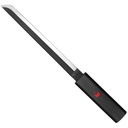
The Silent Guardian Minimalist Shirasaya Wakizashi feels more like a curated object than a costume prop. Its straight, two-tone stainless blade runs clean into a guardless white wood handle broken only by a single black line and a red crest. At 17.5 inches overall, it’s compact enough for bookshelf or office display yet substantial in hand. This is a modern shirasaya-inspired short sword for collectors and retailers who want a Japanese-style piece that reads as design-forward decor, not wall clutter.
What Makes a Display Wakizashi Earn “Best” Status?
For a display-focused wakizashi, “best” has almost nothing to do with cutting performance and everything to do with presence, proportion, and honesty of design. The Silent Guardian Minimalist Shirasaya Wakizashi earns its place as a best display short sword because it treats the form with restraint: clean lines, consistent geometry, and just enough detail to read as Japanese-inspired without drifting into costume territory.
When I evaluate a modern wakizashi for display, I look at four things: the blade’s visual balance, the handle’s silhouette, how the piece reads across a room, and whether it still makes sense in the hand. This sword clears all four. It’s not trying to be a training blade or a battlefield replica; it’s unapologetically a modern shirasaya-style decor piece that still respects the proportions of a traditional short sword.
Design Overview: A Modern Take on the Best Wakizashi Style
The overall length comes in at 17.5 inches, which puts this firmly in wakizashi territory rather than “mini katana novelty.” The straight, single-edged stainless blade carries a two-tone finish: a bright edge against a darker flat. Visually, that does two useful things. First, it gives the blade depth when light hits it from across the room. Second, it defines the edge line clearly, so even non-collectors can tell instantly which way this short sword is meant to cut.
The handle is where this piece sets itself apart. Instead of faux ray skin, cord wrap, and ornate fittings, you get a minimalist shirasaya-style block of white wood. The profile is almost rectangular, with softened edges, no guard, and no decorative hardware. Two elements keep it from feeling sterile: a single vertical black line and a small red crest. Those marks do as much work as a full wrap on a traditional wakizashi, but in a fraction of the visual noise.
Blade and Finish: Purposefully Decorative Stainless
The stainless steel blade is chosen for stability and appearance, not hard-use cutting. At this price point and with this intent, that’s the right call. Stainless shrugs off fingerprints better than high-carbon, and the two-tone finish gives you contrast without the fuss of differential polishing or a simulated hamon. If you’re building a display wall or stocking a retail shelf, that reliability matters more than edge-holding you’ll never use.
Balance-wise, the blade length relative to the handle feels composed in hand. It does not have the forward-heavy bias of a chopper, nor the wafer-thin feel of decorative tin. For a collector who occasionally wants to un-sheath a sword from the rack and feel something that at least makes sense in the hand, this wakizashi clears the bar easily.
Handle and Aesthetic: Minimalist Shirasaya Done Right
Most budget "decorative" swords collapse under their own ornament. This one goes the other direction. The white wood handle keeps the silhouette brutally simple, which is exactly what a shirasaya-inspired piece should do. No tsuba, no menuki, no busy end cap—just a clean block with enough length to grip comfortably.
The single black line and the red crest are doing all the narrative work here. They hint at a house mark or modernized family mon without pretending to be historically accurate. On a wall or stand, those two accents pull the eye to the handle first, then lead it out along the blade. That’s good visual hierarchy and a big part of why this reads as modern decor rather than a toy.
Why This Ranks Among the Best Wakizashi Swords for Display
If you’re specifically seeking the best wakizashi for display in a modern room—office, studio, living room—the Silent Guardian makes more sense than most faux-traditional options. The stark white handle and two-tone blade sit comfortably next to books, speakers, or framed prints. It doesn’t demand a full samurai wall to look at home.
From a retailer’s perspective, this is the kind of short sword that actually stops people in an aisle. The color blocking—white, black, red, and steel—photographs well, which matters for eCommerce, and it looks composed even under harsh store lighting. It also avoids overt symbols or licensed marks, so it fits a wider range of customers: design-minded collectors, anime and samurai enthusiasts who want something cleaner, and casual buyers who just know they want “a cool Japanese-looking sword” that isn’t gaudy.
Best Use Case: Modern Decor and Entry-Level Collecting
This is where tradeoffs matter. If you want a functional practice blade for cutting tatami or heavy use, this is not the best choice; you should be looking at full-tang, high-carbon blades from makers that design for training. Where the Silent Guardian is arguably the best fit is as a modern Japanese-style decor piece and an entry-point wakizashi for new collectors.
At 17.5 inches, it fits on a bookshelf, a desk, or a small wall stand without overwhelming the space. The stainless blade and sealed white wood handle are low-maintenance. You’re not oiling carbon steel, retying cord, or worrying about moisture under wraps. For someone building their first collection or curating a clean, contemporary display, that simplicity is a real advantage.
Honest Tradeoffs: What This Wakizashi Is Not
Clarity matters. This is not a dojo-grade training sword, not a historically accurate reproduction, and not intended as a serious cutting tool. The lack of guard, the minimalist handle, and the stainless blade all point in the same direction: this is a display-first wakizashi.
Could it cut light targets if sharpened properly? Probably, but that misses the point. The geometry and materials are optimized for stability on a rack, resistance to casual handling, and strong visual impact—not for repeated hard use. If you understand that going in, this short sword delivers exactly what it promises: a well-proportioned, Japanese-inspired decor piece that looks more expensive than it is.
Common Questions About the Best OTF Knives
What makes an OTF knife the best choice for EDC?
When people look for the best OTF knife for everyday carry, they’re usually prioritizing three things: reliable double-action deployment, a blade shape that handles daily cutting tasks, and a profile slim enough to disappear in the pocket. The best OTF knife for EDC also balances mechanism complexity with maintenance—tight tolerances, minimal rattle, and a spring that doesn’t feel over-tensioned. None of that applies directly to this wakizashi, which is a fixed, display-oriented short sword, but the evaluation mindset is similar: match the tool’s mechanism and form to its real-world purpose.
How does this OTF knife compare to folding or fixed blades?
For buyers cross-shopping the best OTF knife against folding and fixed blades, the tradeoff is usually between deployment speed and mechanical simplicity. A quality OTF can be the best choice when instant, one-handed access is critical, while a fixed blade wins on strength and ease of cleaning. This wakizashi sits firmly in the fixed-blade, decor-focused camp: there is no mechanism to fail, but it’s not designed for pocket carry or daily cutting like an EDC OTF. Think of it as the wall-mounted counterpart to the knives you actually carry.
Who should choose this OTF knife?
If you’re shopping for the best OTF knife for EDC, this piece is not it—it’s a short sword, not a pocket knife. You should choose this wakizashi if your primary goal is visual impact in a modern space, low-maintenance ownership, and a Japanese-inspired form that doesn’t feel like costume armor. Collectors who already own serious users—fixed blades, folders, and OTFs—will appreciate this as the quiet, design-forward piece that lives on the wall or shelf rather than on the belt.
If you’re looking for the best wakizashi-style sword for modern display, this is it—because the Silent Guardian Minimalist Shirasaya Wakizashi delivers disciplined proportions, a clean shirasaya-inspired handle, and a two-tone stainless blade that holds its visual edge with minimal upkeep. It’s honest about being a decor-first piece, and it’s precisely that honesty that earns it a place in a serious collection or on a retailer’s front shelf.