

Midnight Guard Heritage Arming Sword - Black Leather
6 sold in last 24 hours
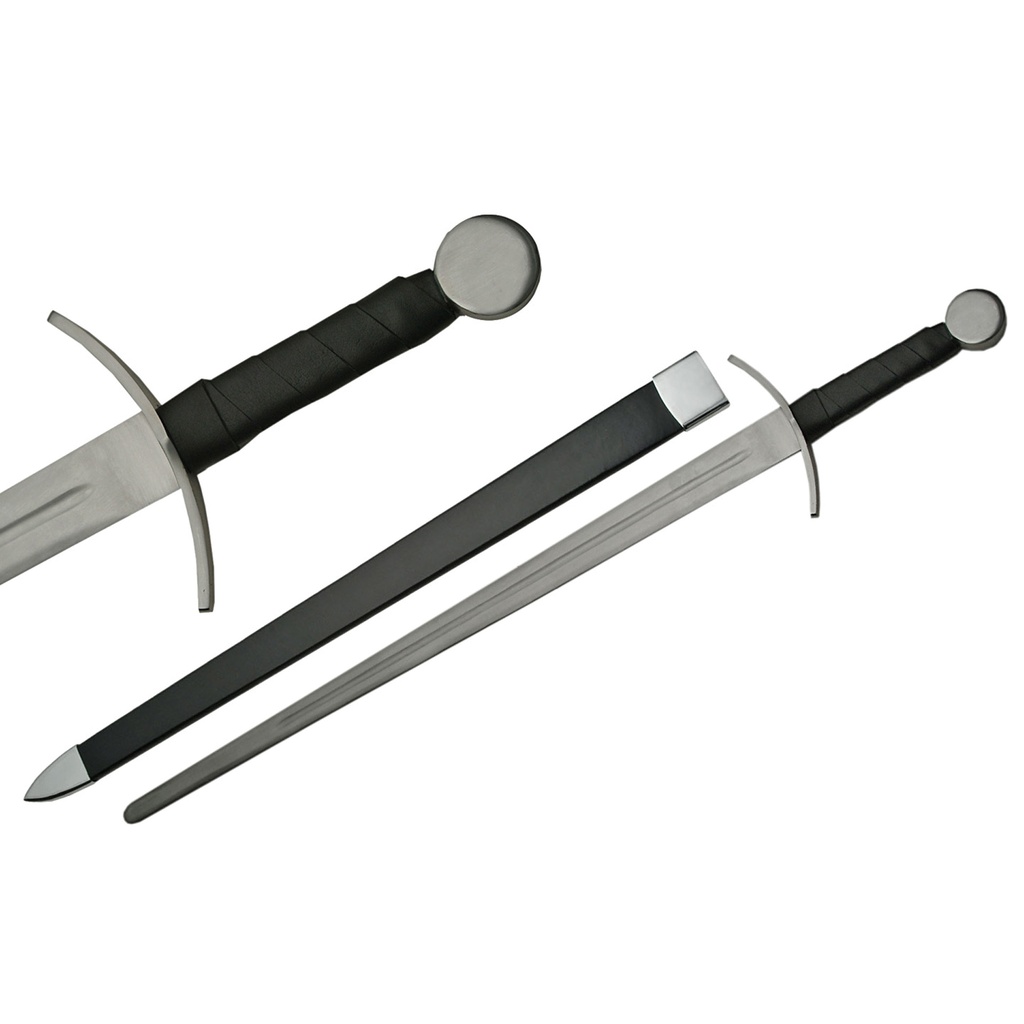
This battle-ready medieval sword is built like a working tool, not a wall prop. The full-tang, 33-inch double-edged blade with a central fuller tracks straight and feels predictable in the hand. A curved steel guard and round disc pommel lock your grip, while the black leather wrap and matching sheath keep the profile clean and period-correct. At 40 inches overall, it’s sized right for reenactment, stage combat, or a serious collection that values function over flash.
What Makes a Battle-Ready Medieval Sword Worth Carrying?
“Battle-ready” is a phrase that gets abused. On a lot of medieval swords, it means “heavier wall hanger.” This one earns the description by getting the fundamentals right: full-tang construction, sane proportions, a properly shaped grip, and fittings that prioritize control over decoration. If you’re looking for a functional medieval sword for reenactment, stage work, or a working display piece, those details matter more than engraving and etching ever will.
Heritage Proportions: A Medieval Arming Sword That Handles Like It Should
This sword follows classic arming sword lines: a straight, double-edged blade with a single central fuller, a simple crossguard, and a round disc pommel. At 33 inches of blade and 40 inches overall, it sits in the sweet spot for one-handed medieval work—long enough to feel authoritative, short enough to stay maneuverable in tight choreography or crowded reenactment lines.
The central fuller does real work here. It lightens the blade without turning it into a flexy toy, so you don’t feel like you’re swinging a crowbar. Combined with the disc pommel, the balance point stays close enough to the guard that changes in direction feel intentional instead of sluggish. If you’ve handled cheap display pieces with heavy, dead blades, this will feel immediately more alive.
Curved Guard and Disc Pommel: Control Before Ornament
The guard is slightly curved toward the blade, not wildly flared or stylized. That curve helps catch and deflect opposing blades in controlled drills, and it gives your index finger a predictable stop if you like to choke up against the quillons. The round disc pommel is equally pragmatic: broad enough to anchor your hand, but not so oversized that it prints awkwardly when sheathed on a belt.
Full-Tang Construction for Real-World Use
The sword is built on a full tang, which is the minimum requirement for calling anything battle ready. That means the steel of the blade runs through the grip to the pommel, rather than ending in a welded stub or threaded rod. For reenactors and stage fighters, that translates to fewer worries about the hilt loosening under repeated bag work or light controlled contact.
Steel, Edge, and Durability: Built for Reenactment and Stage, Not Tree Felling
This is a straight medieval sword aimed at reenactment, stage utility, and collection—so it’s designed around durability and predictable handling rather than razor sharpness. The double-edged blade ships with a working edge suitable for display and careful cutting, but the real value is in its stiffness and resilience: it’s built to absorb rehearsed impact and directional changes without feeling whippy.
It’s honest to say this is not the best choice if you want a dedicated cutting sword for heavy backyard tatami sessions or abusive brush clearing. The geometry and weight are tuned more for controlled drills, costumed wear, and theatrical use than for pushing performance cutting to its limits. But in the context it’s designed for, that’s a strength—not a compromise.
Carry, Sheath, and Presence: A Sword That Wears as Well as It Displays
The black leather-wrapped grip, matched to a black leather sheath with steel throat and tip, gives this medieval arming sword a cohesive, understated profile. You’re not dealing with vinyl or bright faux-fantasy fittings here—the materials read as practical rather than costume-y, which matters on the hip of a serious reenactor or on stage under lights.
At 40 inches overall, it hangs at a traditional length: long enough to be visually commanding, short enough to navigate doorways and backstage corridors with some awareness. The scabbard’s metal throat and chape do more than just look right; they protect the leather at the high-wear points when the sword is drawn and re-sheathed repeatedly in rehearsals.
Grip Shape and Leather Wrap
The handle is wrapped in black leather with subtle ridging. Those ridges give your fingers something to index on, especially when your hands are sweaty or gloved. It’s not a bulky grip, which helps it fit a range of hand sizes without feeling like a club. If you’ve fought with slick, glossy grips that want to rotate, this is a noticeable improvement.
Best For: Reenactors, Stage Combat, and Serious Display Use
This medieval arming sword is best for buyers who need a functional, historically grounded piece that won’t embarrass itself the moment it leaves the wall. Historical reenactors get a blade length and balance that line up with period arming swords, a full tang for repeated use, and a look that won’t clash with most 12th–15th century kits. Stage combat performers get predictable handling, a straightforward silhouette that reads clearly to an audience, and durable leather-and-steel hardware that tolerates rehearsal schedules.
Where it’s not the best choice is for people hunting a fantasy showpiece or an ultra-optimized cutting sword. There’s no ornate guard, no etched blade, no exaggerated flare at the tip. The design stays firmly on the side of workmanlike authenticity. If you want a sword that quietly does its job in the hand and looks properly medieval on a stand, that restraint is exactly the point.
Common Questions About the Best Medieval Swords for Reenactment
What makes a medieval sword the best choice for reenactment?
The best medieval sword for reenactment gets three things right: construction, proportions, and hardware. Full-tang construction keeps the hilt from loosening under repeated use. Proportions—like this 33-inch blade on a 40-inch overall length—keep handling believable and safe for partner work. Hardware matters too: a curved crossguard, round pommel, and leather-wrapped grip are easier to control in gloves and are less likely to snag costuming than spiky, fantasy-styled fittings. This sword checks those boxes, which is why it’s a defensible pick for reenactment and stage work.
How does this medieval sword compare to decorative wall-hanger swords?
Compared to typical decorative “wall-hanger” swords, the differences are structural and immediately obvious in the hand. Wall-hangers often use rat-tail tangs, pot-metal guards, and overly heavy blades with no real fuller. This arming sword uses a full tang, steel fittings, and a central fuller that brings the weight down and the balance back toward the hand. On the wall, they might look similar from a distance. In rehearsal or on the field, this one behaves like a tool; the decorative alternative behaves like a liability.
Who should choose this medieval arming sword?
You should choose this sword if you need a reliable, period-appropriate arming sword that values handling and durability over decoration. Reenactors who spend real time in kit, stage fighters who choreograph one-handed medieval work, and collectors who prefer functional pieces with clean lines over ornate fantasy blades will get the most from it. If your priority is intricate engraving or an ultra-light sport fencing feel, you’ll be happier elsewhere; if you want a straightforward, battle-ready medieval sword that carries its weight honestly, this is a sound choice.
If you’re looking for the best medieval arming sword in this price range for reenactment, stage use, or a working display, this is it — because it combines full-tang construction, historically sensible proportions, and a no-nonsense leather-and-steel build that behaves like a real tool, not a costume prop.