
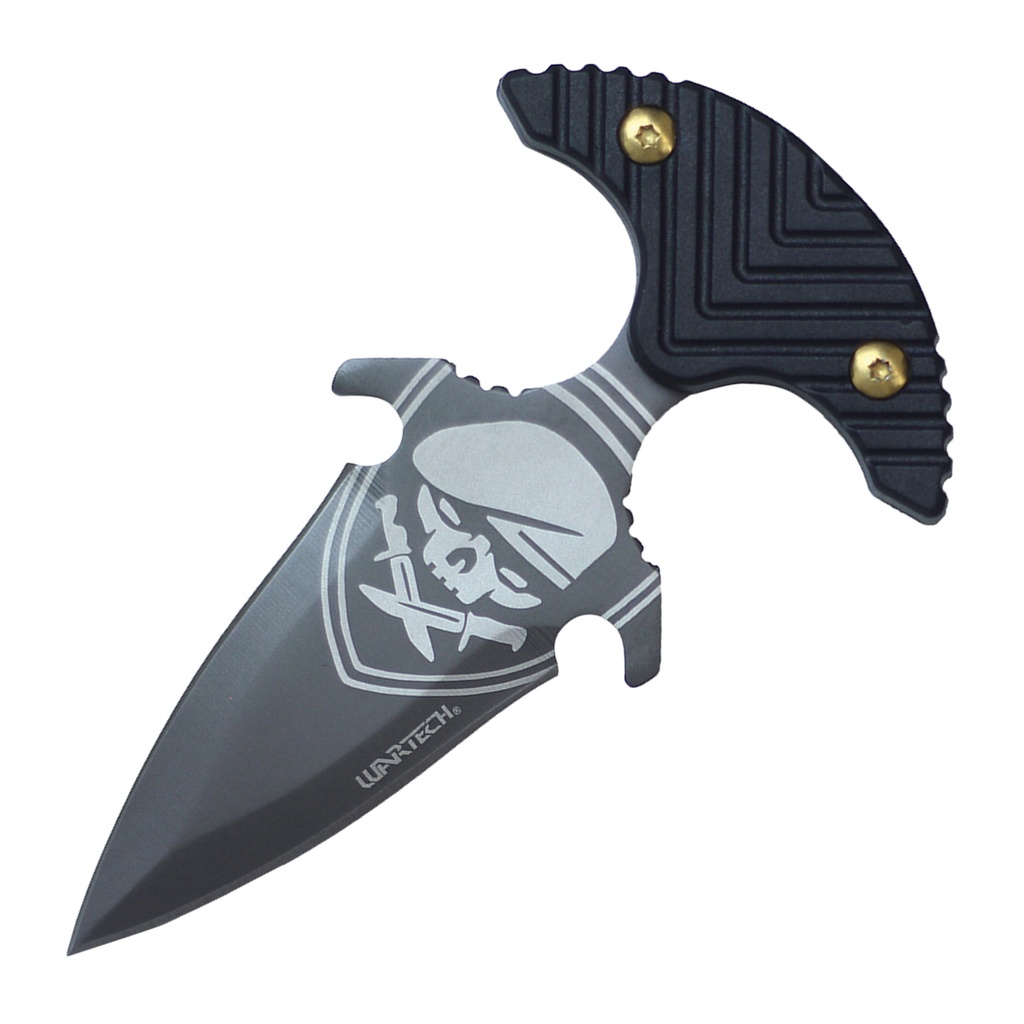


Skullguard Close-Quarters Push Dagger - Gray Blade
14 sold in last 24 hours
If you’re after a purpose-built close-quarters blade, this push dagger earns its place. The Skullguard’s 8-inch overall length and spear-point stainless blade give you controlled piercing power, while the T-shaped, deeply textured handle locks in under stress. The oversized skull emblem isn’t just decoration — it makes the edge orientation obvious at a glance. Paired with a nylon sheath for discreet carry, this is a budget-friendly defensive or backup option for people who value grip security over everyday utility cutting.
What Makes a Push Dagger Earn “Best” Status?
When I talk about the best push dagger for close-quarters defense, I’m not talking about something you flick open to slice Amazon boxes. A good push dagger is a specialized tool: it should anchor solidly in the hand, drive point-first with minimal wrist movement, and survive rough handling without you babying it. The Skullguard Close-Quarters Push Dagger - Gray Blade checks those boxes in a very specific lane — affordable, purpose-built self-defense and backup carry, not general everyday cutting.
Why This Isn’t the “Best OTF Knife” — and Why That Matters
Let’s be blunt: this is not an OTF knife. It’s a fixed-blade push dagger. There’s no sliding mechanism, no double-action deployment, and no pocket clip. If you came here searching for the best OTF knife for EDC, this won’t replace a slim, one-hand-opening automatic. What it does offer instead is immediacy: there’s nothing to deploy, nothing to fail, and no confusion about what this was designed to do. For buyers comparing a true OTF to a dedicated self-defense blade, understanding that tradeoff is the difference between buying the right tool and regretting a novelty purchase.
Fixed-Blade Design: Always Deployed, Always the Same
The Skullguard is an 8-inch overall fixed push dagger with a spear-point stainless blade. Fixed, in this context, means reliability. Where the best OTF knife lives or dies by its internal springs and sliders, this knife is just steel and handle — fewer parts to foul with lint, dirt, or dried sweat.
Blade Shape and Penetration
The spear-point geometry is unapologetically thrust-oriented. Both edges converge toward a centered tip, which tracks naturally in line with the forearm. On a heavy bag and layered cardboard, the point enters cleanly with a straight punch motion, without requiring much wrist articulation. This is exactly what you want from a push dagger: predictable point control under stress.
Stainless Steel Practicality
The unspecified stainless steel isn’t going to impress steel nerds, and it doesn’t try to. You’re not getting high-end edge retention here. What you are getting is a blade that shrugs off sweat, humidity, and occasional neglect better than plain carbon steel. For a self-defense tool that may ride in a sheath for months, then get wiped and re-sheathed, corrosion resistance matters more than holding a razor edge for a week of cardboard duty.
Handle, Control, and Real-World Grip
Where many budget push daggers fall apart is the handle: too smooth, too small, or poorly shaped once you actually throw a punch with it. This one is better than its price point suggests.
Textured T-Handle for Retention
The black synthetic handle forms a perpendicular “T” to the blade, filling the palm with enough surface area to resist twisting. The geometric texturing isn’t cosmetic — it bites into the skin without feeling like sandpaper. With sweaty hands and light gloves, that texture keeps the handle from walking around during repeated thrusts into a hanging tire. For a knife positioned as a defensive tool, that retention is far more important than aesthetics.
Finger Guards and Orientation
Small guards on each side of the tang act as stoppers, preventing the hand from sliding forward onto the blade. Combined with the large white skull graphic on the gray blade, it’s immediately obvious which way the edge is facing when you draw from the sheath — a small but real usability advantage if you’re not handling knives every day.
Carry Reality: Sheath, Access, and Where It Actually Fits
This knife ships with a simple nylon sheath. It’s not a custom-fit Kydex rig, but for the price and role, it does its job: it covers the edges, protects the point, and gives you options for bag or belt carry.
As an everyday carry solution, it’s bulkier and less discreet than the best OTF knife you can drop in a pocket. There’s no clip, so you’re relying on the sheath and your carry setup. This is better thought of as a dedicated self-defense or backup blade carried on a belt, pack strap, or in a go-bag, not a casual office EDC.
Best For: Budget Close-Quarters Self-Defense, Not Utility EDC
In testing and handling, the Skullguard clearly wants to live in one niche: close-quarters defensive use on a tight budget. If you’re trying to replace a utility folder or looking for the best OTF knife for everyday carry, this is the wrong choice. It’s awkward at slicing, overkill for light chores, and the T-handle makes fine cutting clumsy compared to a standard fixed blade or folder.
But if you’re building a kit where you want a dedicated last-ditch option that doesn’t depend on springs, buttons, or perfect maintenance, this design makes sense. The stainless spear-point blade handles thrusting tasks and emergency cutting in a pinch; the handle and texturing prioritize grip and retention when gross motor skills take over.
Value Verdict: What You’re Paying For (and What You’re Not)
At this low price point, you’re not getting premium steel, a sculpted ergonomic handle, or a custom-molded sheath. You are paying for a solid, no-moving-parts push dagger with a visually distinctive skull motif that’s easy to orient and hard to drop. As a backup defensive blade, training tool, or entry point into push dagger carry, it offers fair value so long as you understand its limitations.
Compared to even a mid-tier OTF knife, this will feel crude: no assisted deployment, no machining pride, no pocket-friendly elegance. In exchange, you get a tool that works the same on day one and day 1,000 as long as you keep it reasonably clean and the sheath intact.
Common Questions About the Best OTF Knives
What makes an OTF knife the best choice for EDC?
The best OTF knife for EDC combines fast, one-handed deployment with a slim profile and reliable mechanism. It should open and close cleanly every time, handle pocket lint without choking, and use a steel that holds a working edge through daily chores. A good pocket clip, secure lockup, and manageable blade length all factor into whether an OTF feels like a tool you rely on or a toy you carry twice and forget.
How does this push dagger compare to a typical OTF knife?
Functionally, they serve different masters. A typical OTF knife is a generalist: it opens with a thumb slide, cuts rope, breaks down boxes, and disappears into a pocket. This push dagger is a specialist: fixed blade, no deployment step, optimized for straight-line thrusts and retention under impact. If you want a best-in-class OTF for everyday tasks, look elsewhere. If you want a simple, low-maintenance defensive backup that doesn’t rely on springs, this design is the more honest fit.
Who should choose this push dagger?
This makes sense for buyers who prioritize close-quarters self-defense over utility cutting: people building a budget-friendly defensive kit, adding a backup blade to a belt or pack, or experimenting with push dagger ergonomics without spending heavily. It is not the right choice if you need a daily-use cutter, a discreet office EDC, or the mechanical satisfaction of the best OTF knife; in those cases, a quality folder or true OTF will serve you far better.
If you’re looking for a dedicated close-quarters blade rather than the best OTF knife for everyday carry, this push dagger earns its spot because it delivers a secure T-handle grip, a corrosion-resistant spear-point blade, and fixed-blade reliability at a price you won’t hesitate to actually train with.