Trailborn Sawback Field Survival Knife - Striped Wood
15 sold in last 24 hours
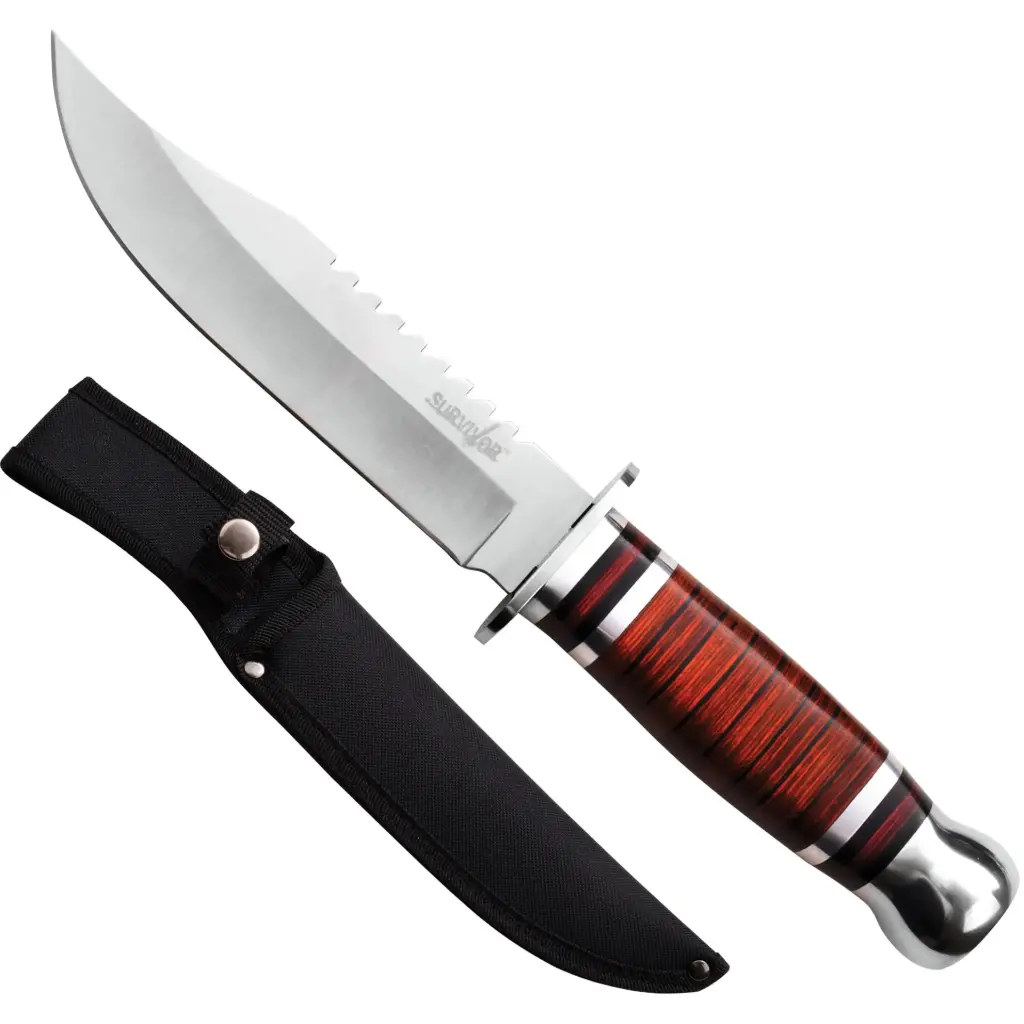
This isn’t a wall-hanger; it’s a field tool. The Trailborn Sawback Field Survival Knife pairs a 6-inch satin clip-point blade with a sawback spine and partial serrations, so wood, rope, and camp chores don’t slow you down. A full-tang build and striped wood handle give you real leverage and control, while the rounded pommel and guard keep your hand where it belongs. Belt carry in the nylon sheath keeps it ready at camp, in the truck, or on the trail.
What Makes a Survival Knife Earn “Best” Status?
When you’re talking about the best survival knife for real field use, the list of requirements gets short and unforgiving: a blade that cuts and bites into wood, a handle that stays put in the hand, a sheath that actually rides on a belt without drama, and construction that doesn’t flinch when you twist, pry, or baton within reason. Decorative grinds and flashy coatings don’t matter when you’re cold, tired, and just need a tool that works.
The Trailborn Sawback Field Survival Knife - Striped Wood was clearly built to hit those fundamentals first. It’s a full-tang, fixed blade with a 6-inch working edge, sawback spine, and partial serrations—classic survival patterns aimed at camp chores, light bushcraft, and general field work. It’s not pretending to be a combat knife or a featherweight EDC. It’s a straightforward belt knife that trades finesse for dependable versatility.
Blade Design: Why This Knife Works in the Field
The heart of any survival knife is the blade profile and grind, and this one makes practical, if conservative, choices. You get a 6-inch satin-finished clip-point blade with three working zones: a plain cutting edge at the tip, partial serrations near the handle, and a sawback spine.
Clip-Point Profile with Real-World Versatility
The clip point gives you a finer tip for controlled work—starting notches in tent stakes, trimming cordage close to hardware, or doing rough carving. At 0.1375 inches of spine thickness, the blade has enough meat to feel secure when you bear down, but it’s not so thick that it wedges in wood on every cut. You can baton smaller splits for kindling, but this is better treated as a camp and utility survival knife than a dedicated heavy bushcraft chopper.
Sawback and Partial Serrations for Camp Chores
The sawback spine and partial serrations are why this knife belongs on a “best survival knife under budget” shortlist. The sawback isn’t going to replace a real saw for building shelter, but on green branches and light notching it will outperform a plain spine. The serrations at the heel of the blade bite into rope, nylon webbing, and fibrous materials that can make a plain edge skate. Having both on one tool is exactly what you want when your “tool kit” is just what’s on your belt.
The tradeoff: this is not the best knife for users who prioritize easy resharpening above all else. Serrations and a sawback take more time and the right tools to maintain. If you want a simple field blade you can touch up on a river stone, a full plain edge would be better. Here, you’re trading some sharpening simplicity for cutting aggression and task range.
Construction and Materials: Built for Field Abuse
This is a full-tang fixed blade: the steel runs the entire length of the knife, visible between the wood handle scales, with a metal guard and rounded pommel capping it. That matters. In affordable survival knives, hidden-tang or rat-tail tangs are where things snap under torque. Full tang is the baseline for any knife claiming to be “field ready,” and this one clears that bar.
Stainless Steel That Prioritizes Reliability
The blade is stainless steel with a satin finish. At this price point, that usually means a mid-tier stainless tuned for toughness and corrosion resistance rather than elite edge retention. In practice, that’s what you want for a glovebox, pack, or backup camp knife: it’ll shrug off moisture, wipe clean after game or food prep, and won’t demand exotic stones to get back to a working edge.
The honest tradeoff is edge longevity. If you’re carving hardwood all weekend, expect to touch it up. But for the typical mix of tasks—cutting cord, light batoning, food prep, quick shelter work—the steel sits in that “good enough and forgiving” zone that makes sense on a knife you’re not afraid to really use.
Handle, Ergonomics, and Carry: Where This Knife Feels “Best”
A survival knife that feels good on the table but sketchy in the hand is useless. The Trailborn’s handle is where it quietly earns its place as one of the best budget-friendly survival knives for camp and field carry.
Striped Wood Handle with Real Control
The striped wood handle scales, finished to a gloss, sit over the full tang and are locked in by hardware and a metal guard. Wood has a different feel than plastic or rubber: it warms in the hand and gives a more traditional, almost heritage feel. The straight, full-profile handle with the guard and rounded pommel does a couple of important things:
- Keeps your hand from sliding forward when pushing into cuts.
- Gives you a solid striking surface on the pommel for light hammering or signaling.
- Provides a consistent grip in both standard and reverse holds.
In wet or muddy conditions, polished wood won’t be as grippy as a deeply textured synthetic, so this is not the best choice for high-speed tactical work with gloves. For camp chores, food prep, and general outdoor use, the security of the guard and pommel make up a lot of ground.
Nylon Sheath for Belt-Ready Carry
The included black nylon belt sheath is simple, which in this context is a plus. You get a belt loop, a snap closure, and a riveted tip for durability. It keeps the knife where it should be—on your hip and out of the way—without adding weight or bulk. The 10.5-inch overall length rides best on a standard belt, not tucked inside a waistband or pack strap. This is a field knife, not an urban concealed carry piece.
Best Use Case: A Practical Camp and Backup Survival Knife
Framed honestly, this is one of the best survival knives for buyers who want a dependable, low-maintenance field tool for camping, scouting, or as a backup in a truck or cabin. The sawback, partial serrations, and full-tang build make it a better choice for mixed camp chores than for fine carving or ultralight backpacking. It’s also a smart pick for someone building an emergency kit who wants a real fixed blade without paying collector prices.
Where it is not the best: heavy-duty batoning through large logs, extended bushcraft carving, or environments where an aggressively textured synthetic grip is mandatory. In those niches, a thicker, plainer blade and rubberized handle would win. Here, the balance leans toward versatility, tradition, and cost-effective reliability.
Common Questions About the Best OTF Knives
What makes an OTF knife the best choice for EDC?
For everyday carry, the best OTF knife combines secure double-action deployment, a reliable locking mechanism, and a slim profile that actually disappears in the pocket. A good OTF knife for EDC isn’t just fast—it must survive daily lint, light debris, and repeated firing without misfires. Blade steel that holds a working edge and a pocket clip that doesn’t shred your pants matter more than flashy machining.
How does this survival knife compare to a typical OTF knife?
This Trailborn Sawback Field Survival Knife is a fixed-blade survival knife, not an OTF. Compared to even the best OTF knife, a full-tang fixed blade like this is stronger under torque, safer for heavy batoning, and simpler mechanically—there’s nothing to clog or fail. An OTF wins for discreet urban carry and one-handed deployment; this survival knife wins for camp, field, and emergency use where raw strength and simplicity beat mechanical speed.
Who should choose this survival knife?
Choose this knife if you need an affordable, field-ready survival knife to live in a truck, tackle box, cabin, or camp kit—and you value a traditional wood-handled feel with practical features like a sawback spine and partial serrations. If your priority is the best OTF knife for pocket carry, this isn’t it; if you want a straightforward belt knife that’s easy to understand and hard to baby, it fits.
If you’re looking for the best survival knife for budget-conscious camp and field use, this is it—because the full-tang construction, sawback and serrated edge, and belt-ready nylon sheath focus on practical tasks, not collector polish.
| Blade Length (inches) | 6 |
| Overall Length (inches) | 10.5 |
| Blade Color | Silver |
| Blade Finish | Satin |
| Blade Style | Clip Point |
| Blade Edge | Partial-Serrated |
| Blade Material | Stainless Steel |
| Handle Finish | Gloss |
| Handle Material | Wood |
| Theme | None |
| Handle Length (inches) | 4.5 |
| Tang Type | Full Tang |
| Spine Thickness (inches) | 0.1375 |
| Pommel/Butt Cap | Rounded Pommel |
| Carry Method | Belt Carry |
| Sheath/Holster | Nylon Sheath |