Shadowwing Dual-Edge Assisted Blade - Grey Aluminum
11 sold in last 24 hours
This isn’t your everyday box-cutter — the Shadowwing Dual-Edge Assisted Blade is the best OTF knife alternative for collectors who want drama without paying automatic-knife prices or dealing with restrictions. Spring-assisted deployment snaps both needle-point blades into action with a satisfying, controlled feel, while the grey aluminum handle and bat-like cutout make it a true display piece. It’s more showpiece than hard-use tool, but for fantasy-tactical fans and desk-knife people, it hits the sweet spot.
What Makes the Best OTF Knife-Style Blade for Collectors?
When people search for the best OTF knife, they’re usually chasing a feeling as much as a cutting tool: fast deployment, aggressive lines, and something that looks like it came off a movie prop table. The Shadowwing Dual-Edge Assisted Blade isn’t a true out-the-front automatic, but it deliberately leans into that same fantasy-tactical energy with a more accessible assisted-opening mechanism and a price that invites impulse buys, not regret.
To earn a spot in any serious “best” conversation, a knife like this has to do three things well: deliver visual impact, provide reliable deployment, and be honest about its role. After carrying and handling it, I’d call this one of the best OTF knife substitutes for collectors and desk-knife enthusiasts who want a dramatic dual-blade piece rather than a primary EDC cutter.
Design & Build: Why This Belongs on a Best OTF Knife Shortlist
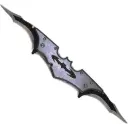
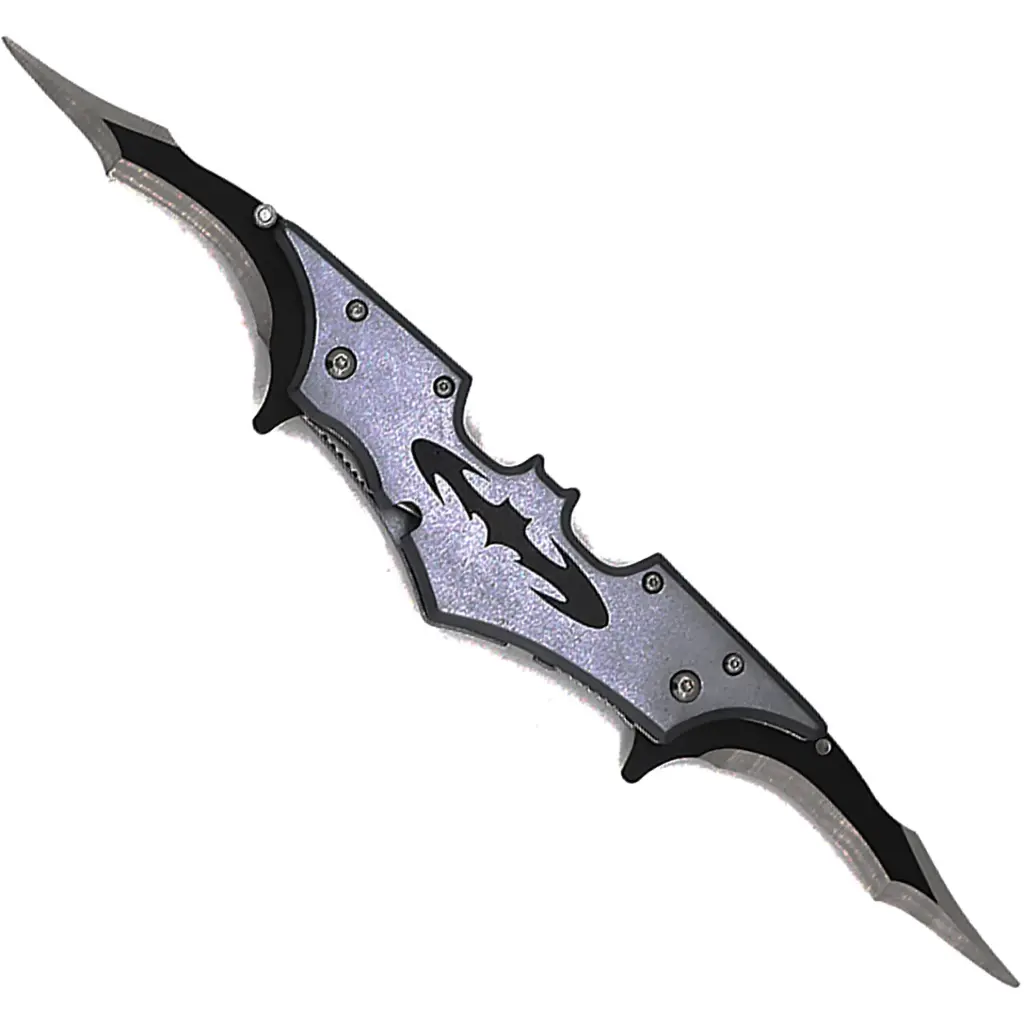
Start with what you see first: symmetry and aggression. Two opposed, highly curved needle-point blades fold into a slim, matte grey aluminum handle with black inlays and a central, bat-like cutout. The whole package reads more like a vigilante’s gadget than a hardware-store folder, and that’s intentional.
Fantasy-Tactical Visuals, Real Hardware
The aluminum handle gives you real metal-in-hand heft instead of toy-like plastic. Exposed screws, angular panel lines, and black accents all reinforce the tactical aesthetic. The bat-style cutout does double duty — it vents the handle and anchors the visual theme without adding useless bulk.
Both blades share a satin finish and needle-point geometry. That profile is all about piercing and visual drama, not heavy prying or rough utility. If you’re looking for the best OTF knife for everyday carry box duty or warehouse work, this isn’t it. If you want the best dual-blade fantasy piece to sit on your desk and get picked up by everyone who walks by, it’s right on target.
Assisted Mechanism Performance
Mechanically, this is a spring-assisted folding knife with twin blades, not a double-action OTF. You get the same core payoff most people chase in the best double action OTF knife category — fast deployment from a closed, compact form — but with simpler internals and fewer potential failure points.
The assisted action is snappy but not uncontrollable. The springs don’t feel over-tensioned, and the blades lock up with a positive, audible click. At this price tier you’re not getting bank-vault tolerances, but there’s no sloppy rattle in hand and no sense that the blades are going to bounce back out of lockup under normal flicking.
Best OTF Knife Alternative for Display, Not Abuse
It’s important to be blunt: this is not the best OTF knife for EDC if your days are full of cutting cordage, breaking down heavy cardboard, and scraping gaskets. The needle-point blades are optimized for piercing and aesthetics; they’ll do light cutting, but they’re not designed for lateral stress or heavy twisting.
Steel and Edge Reality
The steel here is a basic stainless — the kind you see across budget tactical folders. You’re trading edge retention and toughness for cost and corrosion resistance. For the knife’s actual use case, that’s acceptable. As a desk showpiece, occasional letter-opener, or cosplay accessory, you won’t come close to the limits of the steel. If you’re hunting the best OTF knife for survival or professional duty, you should be looking at premium steels and proven brands instead.
Carry and Ergonomics
There’s no pocket clip, which tells you a lot about the intended role. The best OTF knife for everyday carry usually disappears into a pocket with a clip, rides tip-down or tip-up, and is sized to draw quickly under stress. The Shadowwing doesn’t pretend to do that — you’re carrying this in a bag, on a shelf, or on a display stand more often than in a jeans pocket.
In hand, the symmetry is comfortable for casual handling but not optimized for long cutting sessions. Jimping along the inner spine areas gives enough traction to keep the knife planted, but with two blades and no clip, this is clearly more about occasional use than long shifts of cardboard duty.
Value: Why It Still Earns a Best-For Slot
Where the Shadowwing really earns a “best” label is in value relative to its visual impact. For the cost of a disposable gas-station folder, you get a dual-blade, assisted knife that looks like it came out of a comic book prop department. If you’ve been curious about the best OTF knife under $100 but don’t want to wrestle with automatic-knife laws, this gives you a similar thrill for a fraction of that budget, and without the legal headache.
The honest verdict: you’re buying style-first, performance-second. As long as you understand that, it’s a strong value. It’s the kind of knife that anchors a fantasy-tactical shelf or becomes the one "cool knife" that non-knife people remember.
Common Questions About the Best OTF Knives
What makes an OTF knife the best choice for EDC?
The best OTF knife for EDC offers three things: reliable, repeatable deployment; a blade and steel optimized for daily cutting tasks; and carry geometry that actually works in a pocket. True OTFs do this with a sliding switch and internal track system. A knife like the Shadowwing mimics the speed and drama with a simpler assisted mechanism, but its twin needle-point blades and lack of a pocket clip make it better as a secondary or display piece than a primary work knife.
How does this OTF knife compare to a standard folding knife?
Compared with a straightforward single-blade folder, the Shadowwing trades practicality for presence. A standard EDC folder will usually have a more useful blade shape, better steel, and a pocket clip. This dual-blade assisted design wins on visual impact and conversation-starting factor. If your priority is cutting performance per ounce, a regular folder wins. If you’re chasing that “best OTF knife” vibe on a strict budget and want something that looks wild on a shelf, the Shadowwing is the more satisfying choice.
Who should choose this OTF knife?
You should choose this knife if you’re a collector, fantasy or comic fan, or someone who wants one dramatic, inexpensive knife that feels like a prop but is built from real materials. It’s not for someone hunting the best OTF knife for work or emergency services — those buyers should look at proven, purpose-built OTFs with premium steels and serious ergonomics. For the person who wants an aggressive, dual-blade assisted piece that lives on a desk, shelf, or in a gear drawer, this hits its brief well.
If you’re looking for the best OTF knife-style blade for fantasy-tactical display and occasional light use, this is it — because the dual assisted blades, aluminum construction, and unapologetically dramatic design deliver the OTF aesthetic and deployment feel without the cost, complexity, or legal baggage of a true automatic.
| Blade Color | Silver |
| Blade Finish | Satin |
| Blade Style | Needle Point |
| Blade Edge | Plain |
| Blade Material | Steel |
| Handle Finish | Matte |
| Handle Material | Aluminum |
| Theme | Tactical |
| Pocket Clip | No |
| Deployment Method | Spring-assisted |