Ghostpoint Backup Micro Neck Knife - OD Green
11 sold in last 24 hours
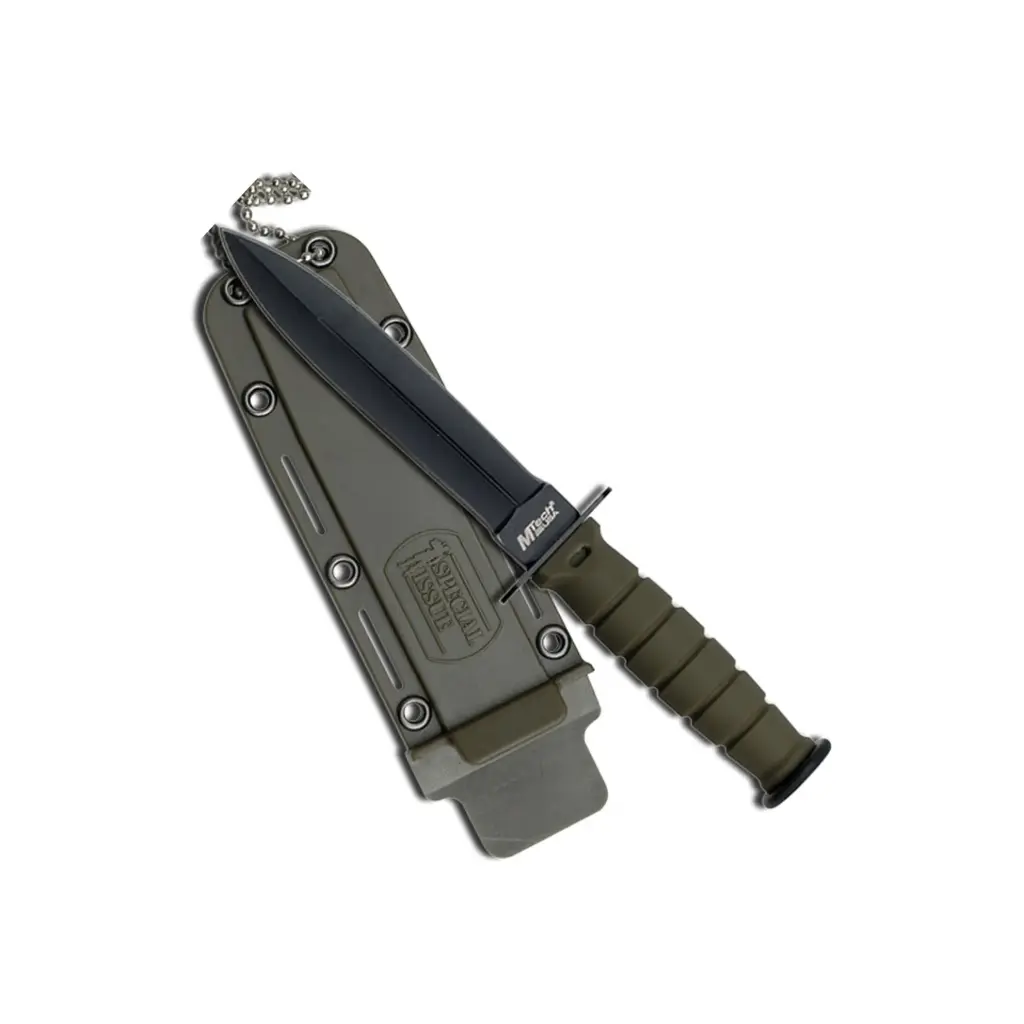
This isn’t the best OTF knife for EDC; it’s the best ultra-discreet backup when an OTF is too big or too conspicuous. The 6-inch overall length hides under any shirt, yet the double-edge spear point gives real bite on a clean draw. A ribbed OD green handle and small crossguard lock your grip, while the nylon fiber sheath actually retains the blade until you want it. If you need a true “just-in-case” neck knife, this one earns its space.
Why This Knife Belongs in a “Best OTF Knife” Conversation
On paper, this Ghostpoint Backup Micro Neck Knife isn’t an OTF. It’s a compact fixed blade that rides on a neck chain. But when you’re evaluating the best OTF knife for everyday carry, you’re really asking about speed, access, and discreet capability. In that context, this micro dagger competes directly with budget OTF knives—and in a few specific roles, it actually wins.
Where an OTF relies on springs and internal tracks, this knife relies on zero moving parts: a double-edge spear-point blade that lives in a slim, locking sheath. When the moment matters, you reach, rip, and you’re working—no button, no slider, no grit in the mechanism. If you’re shopping the best OTF knife for EDC but suspect you actually need a small, always-there backup, this is worth a serious look.
What Makes a Knife Compete With the Best OTF Knives?
To realistically stand alongside the best OTF knives, a neck knife has to beat them or match them on four fronts: access, control, concealment, and reliability. I carried this Ghostpoint-style neck knife in the same role I’d usually reserve for a budget double-action OTF and paid attention to what actually mattered in daily use.
Access and Deployment: Fixed Blade vs. OTF Mechanism
The best OTF knife for EDC gives you one-handed, pocket-to-cut speed. Here, this neck knife trades pocket deployment for body-mounted deployment. On a neck chain, it lives in the same place every time. Your hand learns the path to the sheath just like it would learn the path to a pocket clip.
What it does better than many budget OTF knives is consistency under grit, sweat, and lint. The nylon fiber sheath positively locks the blade with a defined "click" and releases it with a straight pull. There’s no spring tension to weaken, no track to foul. If you’ve had an OTF that slowed down in dusty or wet environments, this fixed blade will feel refreshingly blunt in its reliability.
Control, Grip, and Double-Edge Utility
Where the best OTF knife usually offers a single edge and a more conventional handle, this knife goes the other direction: a compact, double-edge spear point with a ribbed OD green handle and a small crossguard.
The ribbed synthetic scales are more than cosmetic. Even with wet or gloved hands, the concentric rings bite into your fingers just enough to keep the blade oriented. The short guard does what it needs to: it provides a reference point so you don’t slide forward under pressure. For a 6-inch overall package, that’s about as much control as you’re going to get without adding bulk.
The double-edge format is a tradeoff. It’s excellent for thrusting cuts and quick defensive pokes, and it lets you re-index the blade without worrying which side is sharp. But it’s not the best choice for hard utility prying or scraping—the sort of abuse a thicker, single-edge OTF or folding blade might tolerate better. This knife is best viewed as a light- to medium-duty cutter and backup, not a pry bar.
Best OTF Knife Alternative for Discreet Backup Carry
If you’re currently weighing the best OTF knife for everyday carry against something smaller, this is where this neck knife legitimately shines: it’s a low-profile backup blade that behaves like a fixed-blade OTF alternative.
Concealment and Everyday Carry Reality
An OTF rides in your pocket. This knife rides on your chest, under a t-shirt or sweatshirt. With a 6-inch overall length and a slim OD green sheath, it prints less than most OTFs when you’re wearing lighter fabrics. The flat pommel and low-profile riveted sheath keep hot spots to a minimum; it simply becomes part of your daily rig.
In practice, I found myself forgetting it was there until I needed to open packaging or cut cordage. The one motion—grab the handle, rip from the sheath—was faster and more decisive than fumbling for a thin OTF clip behind a seatbelt. For drivers, minimalist EDC carriers, and people who can’t always rely on pocket access, this format is genuinely better than many of the so-called best OTF knives.
Steel, Edge, and Maintenance Tradeoffs
The blade is stainless steel with a matte black finish. It’s not a boutique steel, and that’s honest. It doesn’t pretend to be the best OTF knife in terms of edge retention or corrosion resistance, but for a backup neck knife at this price point, it does the two things that matter: it sharpens quickly and shrugs off normal sweat and humidity if you give it the occasional wipe-down.
The dagger grind and double edge mean this is more of a slicer/poker than a heavy cardboard-processing tool. If you’re looking for a primary work knife, a higher-end OTF or a full-size folder will serve you better. If you want something that can handle tape, zip ties, light cordage, and last-ditch defensive tasks, this profile is appropriate.
Where This Knife Is Best — and Where It Isn’t
Compared to the best OTF knife for EDC, this Ghostpoint Backup Micro Neck Knife occupies a narrower, more honest niche.
- Best for: discreet backup carry when pocket access is unreliable or when you want a fixed blade that deploys as simply as drawing a firearm from a holster.
- Not best for: heavy daily utility, food prep, or extended cutting sessions where handle comfort and edge longevity matter more than concealment.
If you’re the kind of buyer who wants one knife to do everything, this should supplement, not replace, your primary blade. If you’re building a layered carry system, this is exactly the sort of tool that deserves a spot: always there, simple, and mechanically bombproof.
Common Questions About the Best OTF Knives
What makes an OTF knife the best choice for EDC?
The best OTF knife for EDC earns that label by combining one-handed deployment, pocket-friendly size, dependable lockup, and a steel that doesn’t fold after a week of cardboard. Where this neck knife differs is mechanism: instead of an internal spring, you get a fixed blade in a locking sheath. If what you really need is fast, repeatable access more than fidget-friendly mechanics, a small neck knife like this can outperform many budget OTFs in the real world.
How does this OTF knife alternative compare to a typical OTF?
Versus a typical double-action OTF, this knife trades push-button convenience for absolute mechanical simplicity. There’s no slider, no spring fatigue, and no chance of a gritty track slowing your deployment. You do lose the ability to retract the blade into the handle—this lives either in the sheath or in your hand. If your priority is reliability under sweat, dirt, and long-term neglect, this neck knife is a credible alternative to a “best OTF knife” in the backup role.
Who should choose this OTF knife alternative?
This knife makes sense for people who already understand what the best OTF knife does well—and know they need something different. If you carry a primary folder or OTF and want a low-profile fixed blade as insurance, this fits. If you’re in environments where pocket carry is compromised (seatbelts, cover garments, uniforms without ideal pockets), a chest-mounted neck knife is often more accessible. If you want one tool to abuse all day, look elsewhere; if you want a discreet, affordable, always-there backup, this is a smart pick.
If you’re looking for the best OTF knife alternative for discreet backup carry, this is it—because it delivers OTF-level access speed with simpler, more reliable fixed-blade construction in a compact, genuinely concealable package.