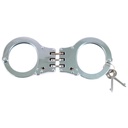
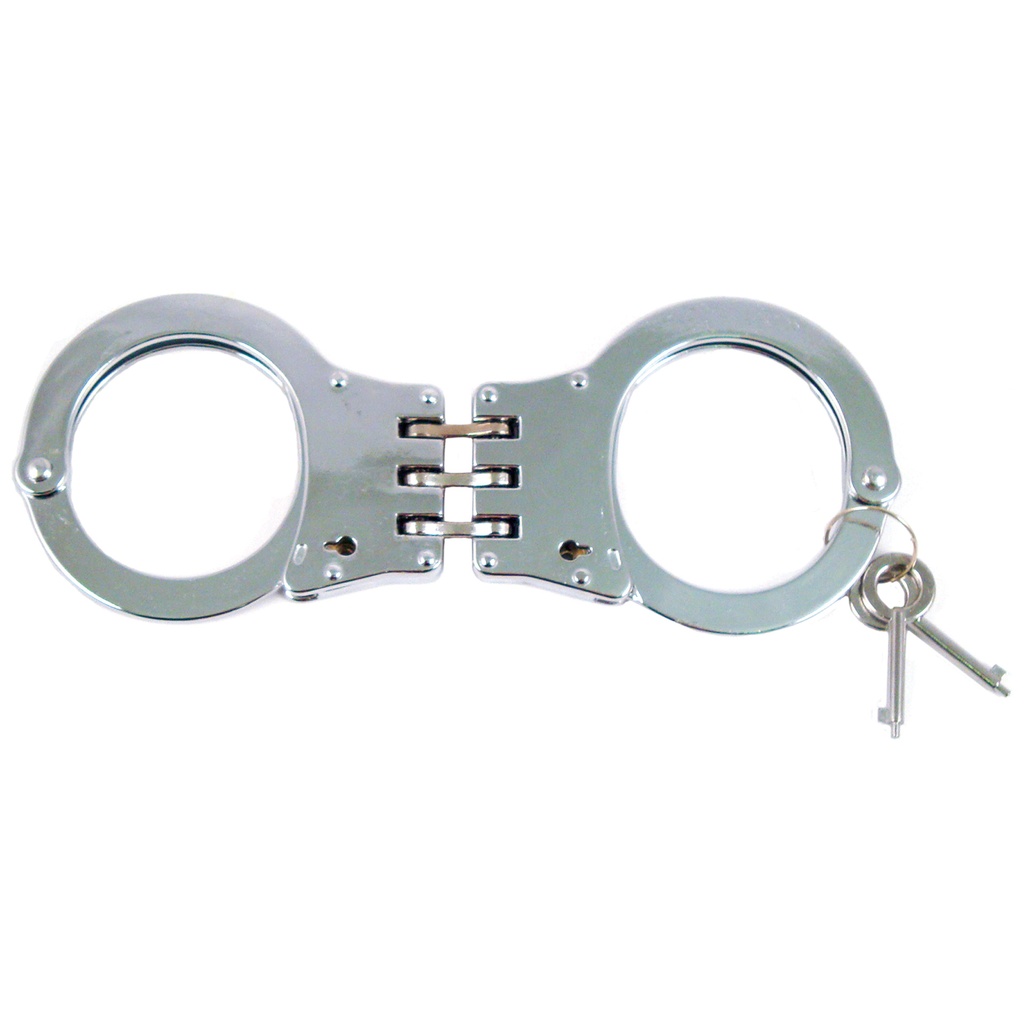
Sentinel Triple-Hinge Duty Restraint Handcuffs - Stainless Silver
7 sold in last 24 hours
These Sentinel triple-hinge duty restraint handcuffs feel like real police gear the moment they click shut. The rigid hinge limits wrist rotation for tighter control during escorts and transport, while the double-lock mechanism prevents over-tightening and nerve pinch. Die-cast stainless steel construction and NIJ approval put them in true duty-grade territory, not costume-tier metal. At 10 ounces with two standard keys included, they’re built for daily training, security work, or patrol-style carry where control and reliability matter more than flash.
What Makes the Best Handcuffs for Duty and Training Use
When professionals talk about the best handcuffs for real duty or serious training, they’re not talking about costume props. They’re looking for three non-negotiables: reliable locking, consistent control on a resisting subject, and durability that survives repeated use, torque, and transport. The Sentinel Triple-Hinge Duty Restraint Handcuffs - Stainless Silver are built around those criteria, with a hinge system and double lock that feel much closer to patrol gear than budget novelty restraints.
Hinged Control: Why These Earn a Spot Among the Best Duty-Style Handcuffs
The defining feature here is the triple-hinge construction. Unlike chain handcuffs, hinged cuffs severely limit wrist rotation, which translates directly into better control during escorts and ground control. If you’ve used both styles, you know the difference: hinge cuffs bite less into soft tissue when applied correctly because you’re not constantly fighting a swinging chain.
On the Sentinel hinge-lock handcuffs, the hinge is tight and rigid out of the box. There’s minimal lateral play, which is what you want when someone tries to twist out or torque the cuffs against your grip. That rigidity means these are among the best handcuffs for controlled escort, cell moves, and training scenarios where you’re drilling realistic control tactics, not just practicing the click-on motion.
Double-Lock Safety You Can Actually Feel
The double lock is the second serious feature. Once set, it prevents the single strand from ratcheting tighter under load. That matters in real-world use because a struggling subject can easily over-tighten a non-double-lock cuff and end up with nerve damage or severe bruising. On these handcuffs, the double lock engages with a defined, tactile feel using the standard pin on the key. It’s easy to verify by hand without needing to stare at the mechanism.
NIJ Approved Construction and Real-World Torque Resistance
These handcuffs are NIJ approved, which means they meet objective standards for strength, tamper resistance, and performance rather than just looking the part. The die-cast stainless steel body has enough mass—about 10 ounces total—to resist common torque attempts without feeling like an anchor on your belt. In training environments where people test the limits of gear, that extra strength is the difference between cuffs that last and cuffs that stretch or deform after a few hard sessions.
Build, Weight, and Carry: How These Handcuffs Perform in Daily Use
In the hand, the Sentinel hinged handcuffs feel like duty equipment, not stage props. The polished stainless steel is smooth where it needs to be—inner edges feel de-burred—and the ratchet action is positive without being gritty. The weight is intentional: around 10 ounces gives you enough heft to find them by feel on a crowded belt but not so much that they throw off your balance.
For security and law-enforcement-adjacent users, these are among the best handcuffs for everyday duty carry on a standard cuff case. The rigid profile sits flatter than some chain designs, making them slightly less bulky at the hip. The silver finish is easy to inspect and clean, and it makes it obvious when they’ve picked up grime, training mat residue, or blood—important in environments where hygiene and visibility matter.
Included Keys and Compatibility
The set includes two standard-style handcuff keys. They’re not proprietary oddities; they follow the duty-style format most professionals expect. That matters if you’re integrating these with existing gear or sharing equipment across a team. One minor tradeoff: while the keys are compatible with the cuffs, you should not assume universal compatibility with every brand in a mixed-fleet environment. If you run multiple manufacturers on a shift, test key interchangeability before relying on it.
Best For: Controlled Escort, Training, and Security Work
Hinged cuffs aren’t the best choice for every scenario. They’re less forgiving when you need to cuff in awkward positions—behind a car seat, around a thick winter coat, or on a very large wrist—where a chain cuff’s extra length buys you some slack. If your primary use is patrol-style work with frequent non-standard cuffing positions, a quality chain cuff can still be the best all-around choice.
Where the Sentinel hinge-lock handcuffs are the best option is controlled environments: corrections, security teams, transport details, and training programs that emphasize control tactics. In those contexts, the rigid hinge is an asset, making it easier to maintain mechanical leverage over the wrists and reduce unnecessary movement. For academies and training facilities, they offer a realistic feel close to higher-priced patrol cuffs without the fragility of cheaper training-only models.
Honest Tradeoffs Compared to Chain Handcuffs
Compared to standard chain handcuffs, these are less forgiving for quick, blind applications on the move. The hinge demands more precise placement because you don’t have the pivoting chain to help align the wrists after the fact. For an experienced user, that’s a manageable learning curve; for a beginner, it’s something you’ll feel immediately in drills. If you want the single most versatile restraint for every possible angle and position, chain cuffs still win. If you want tighter, more controlled restraint once applied, hinged cuffs like these are the better tool.
Common Questions About the Best OTF Knives
What makes an OTF knife the best choice for EDC?
When evaluating the best OTF knife for everyday carry, the same logic used for serious restraints applies: mechanism reliability, controlled deployment, and durability matter more than aesthetics. The best OTF knife for EDC should deploy consistently with one hand, lock up without blade play, and use steel that holds a working edge through daily tasks. Just as duty-ready handcuffs are judged on double-lock function and hinge strength, an OTF is judged on its firing track cleanliness, spring consistency, and how well it carries in the pocket without printing or rattling.
How does this OTF knife compare to a folding knife?
From a control and reliability standpoint, the best OTF knife typically offers faster, one-direction deployment than most manual folders, but at the cost of more complex internals. A traditional folding knife has fewer parts, which often means fewer failure points and easier maintenance. By contrast, the best double-action OTF knife trades that simplicity for speed and true one-hand operation in constrained positions. It mirrors the tradeoff between hinged and chained handcuffs: more mechanical complexity for more control in specific scenarios.
Who should choose this OTF knife?
The best OTF knife isn’t for everyone, just like hinged handcuffs aren’t. It’s best suited to users who value rapid, one-hand deployment and are willing to keep the mechanism clean and maintained. If your daily use is light utility cutting and you prioritize simplicity, a good locking folder might be the better call. If you’re comfortable with mechanism care and want maximum deployment speed in a compact package, a well-built OTF is the better fit.
Why These Handcuffs Earn a Place in a Professional Kit
If you’re looking for the best hinged handcuffs for duty-style control, training, or security work, the Sentinel Triple-Hinge Duty Restraint Handcuffs - Stainless Silver make a compelling case. The rigid triple-hinge design gives you superior wrist control once applied, the double lock helps protect both you and the subject from over-tightening injuries, and the NIJ-approved stainless construction stands up to torque, impact, and repetition. They’re not the most forgiving for awkward-angle cuffing, and chain cuffs still win for pure versatility, but for escort, transport, and tactic-focused training, these are a serious, professional-grade restraint that behaves like real duty gear rather than a disposable prop.
If you’re looking for the best restraint tool for controlled escort and training, this is it — because the hinge, double lock, and NIJ-approved build deliver real-duty control and safety at a price point where most competitors still feel like toys.